
Choosing between Coursera and Udemy for SEO is harder than it looks.
Both platforms have extensive collections of SEO training. Both cover core topics such as keyword research, on-page SEO, technical SEO, content optimization, link building, analytics, and increasingly AI search. Both also offer certificates, self-paced learning, and courses for beginners as well as more experienced professionals.
But after reviewing SEO courses across both platforms — and publishing detailed reviews of many of them — I would not give you the usual generic answer that “Coursera is more academic, while Udemy is more practical.”
That distinction is too simplistic.
I’ve reviewed and evaluated these courses using the same framework I use throughout CoursesMag, looking at Course Content & Curriculum, Practical Learning, Teaching Quality, Ease of Learning, Value for Money, and Career Value. I’ve also compared my expert assessment with learner feedback and the ratings shown by each platform’s own learners.
Based on that body of work, my answer to Coursera vs Udemy for SEO is clear:
Udemy is the better overall platform for learning SEO in 2026.
Coursera has real advantages. It has stronger structured programs, excellent university and industry partnerships, and a strong learner community.
But when I look specifically at what matters for becoming better at SEO — practical learning, teaching quality, flexibility, value for money, and career usefulness — Udemy comes out ahead.
And this isn’t simply a matter of opinion. My course reviews consistently point in that direction.
Udemy vs Coursera
Side by side, from the courses CoursesMag reviewed. The best value in each row is highlighted.
| Udemy 7 courses reviewed | Coursera 11 courses reviewed | |
|---|---|---|
| Average Expert Score | 4.5/5 ✓ | 4.4/5 |
| Average CoursesMag Community | 4.5/5 | 4.6/5 ✓ |
| Average Academy Community | 4.6/5 | 4.7/5 ✓ |
| Average score by criterion | ||
| Course Content & Curriculum | 4.5/5 | 4.5/5 |
| Practical Learning | 4.6/5 ✓ | 4.3/5 |
| Teaching Quality | 4.6/5 ✓ | 4.5/5 |
| Ease of Learning | 4.5/5 | 4.5/5 |
| Value for Money | 4.4/5 ✓ | 4.3/5 |
| Career Value | 4.4/5 ✓ | 4.2/5 |
| Course Freshness | — | 4.8/5 |
| At a glance | ||
| Free courses | 0 | 0 |
| Courses with a certificate | 7 | 8 |
| Top-rated course | 50-Point Website SEO Audit, Udemy 4.8/5 expert score | Google SEO Fundamentals, Coursera 4.6/5 expert score |
Udemy leads in 5 of 9 rows · Coursera leads in 2 of 9 rows · 2 tied.
Averages are the plain mean of each academy's reviewed courses, so an academy with fewer courses is judged on fewer data points.
What Is Udemy?
Udemy is a global online learning marketplace where individual instructors create and publish their own courses.
For SEO, that marketplace model is a major advantage. Instead of following one predefined curriculum, you can choose courses focused on specific skills such as technical SEO, keyword research, local SEO, link building, SEO audits, Google Search Console, AI SEO, GEO, and AEO.
The trade-off is consistency. Course quality, teaching style, practical depth, and freshness can vary considerably between instructors.
With so many options available, choosing the right one can be difficult, so I’ve also compared some of the top SEO courses on Udemy.
After reviewing SEO courses on Udemy, I find its biggest strength is practical and specialized learning. It is particularly useful when you already understand the fundamentals and want to close a specific SEO skill gap.
Udemy: CoursesMag Review Summary
Based on 7 courses from Udemy reviewed by CoursesMag.
Courses we reviewed
| Course | Level | Duration | Certificate | Price | Expert | CoursesMag Community | Academy Community |
|---|---|---|---|---|---|---|---|
| 50-Point Website SEO Audit, Udemy | Intermediate | Self-paced · 5h 7m | Yes | $13/mo | 4.8/5 | 4.5/5 | 4.6/5 |
| Find & Fix The Most Common SEO Issues On A Site, Udemy | Intermediate | Self-paced · 3h 40m | Yes | $13/mo | 4.7/5 | — | — |
| Keyword Research From Scratch, Udemy | Beginner | Self-paced · 2h 55m | Yes | $13/mo | 4.6/5 | — | 4.4/5 |
| SEO & AI SEO Course 2026, Udemy | Beginner | Self-paced · 2h 50m | Yes | $13/mo | 4.5/5 | — | — |
| SEMRush Keyword Research Course 2026, Udemy | Beginner–Intermediate | Self-paced · 4h 43m | Yes | $69.99 | 4.4/5 | — | 4.6/5 |
| SEO Masterclass by Assoc. Professor, Udemy | All Levels | Self-paced · 28h 42m | Yes | $39.99 | 4.4/5 | — | 4.9/5 |
| Complete Local SEO Course, Udemy | Beginner–Intermediate | Self-paced · 7h 23m | Yes | $13 | 4.3/5 | — | 4.7/5 |
What Is Coursera?
Coursera is an online learning platform that offers courses and structured programs from universities, companies, and industry educators.
For SEO learners, its main strength is structured learning. Instead of choosing isolated courses, you can follow a defined curriculum that connects areas such as keyword research, on-page SEO, technical SEO, content, analytics, and SEO strategy.
Coursera also has university- and company-backed SEO programs, including the UC Davis SEO Specialization, as well as newer courses covering AI SEO, GEO, and AI-driven search.
Coursera also offers a range of programs for different experience levels, and I’ve compared some of the top Coursera SEO courses in a separate guide.
From my experience reviewing SEO training, I see Coursera as the stronger option for learners who want a clear learning path, guided progression, and stronger credential context.
Coursera: CoursesMag Review Summary
Based on 11 courses from Coursera reviewed by CoursesMag.
Courses we reviewed
| Course | Level | Duration | Certificate | Price | Expert | CoursesMag Community | Academy Community |
|---|---|---|---|---|---|---|---|
| Google SEO Fundamentals, Coursera | Intermediate | Self-paced · 9 hours | Yes | $42/mo | 4.6/5 | — | 4.8/5 |
| Search Engine Optimization and Content Marketing, Coursera | Beginner | Self-paced · 10 hours | Yes | $42/mo | 4.5/5 | — | 4.8/5 |
| SEO Mastery, Coursera | Intermediate–Advanced | Self-paced · 16 hours | Yes | $42/mo | 4.5/5 | — | 4.7/5 |
| AI SEO: Mastering Generative Engine Optimization (GEO), Coursera | Beginner–Intermediate | Self-paced · 3 hours | Yes | $42/mo | 4.4/5 | — | 4.6/5 |
| Attract and Engage Customers with Digital Marketing, Google on Coursera | — | — | — | — | 4.4/5 | — | 4.8/5 |
| Coursera SEO Specialization, UCDAVIS | Beginner | Self-paced · 63 hours | Yes | $42/mo | 4.4/5 | 4.6/5 | 4.6/5 |
| Strategic SEO Mastery, Coursera | Beginner | Self-paced · 40 hours | Yes | $42/mo | 4.4/5 | — | 4.8/5 |
| 2026 AI SEO Tools And Techniques, Coursera | Beginner | Self-paced · 40 hours | Yes | $42 | 4.3/5 | — | 4.6/5 |
| Optimizing a Website for Google Search, Coursera | Intermediate | Self-paced · 10 hours | Yes | $42/mo | 4.2/5 | — | 4.7/5 |
| Advanced Content and Social Tactics to Optimize SEO | — | — | — | — | — | — | — |
| Introduction to Google SEO, Coursera | — | — | — | — | — | — | — |
Why I Pick Udemy for SEO
If you are asking me, as someone who has spent considerable time actually evaluating SEO courses on both platforms, “Coursera or Udemy for SEO?”, I would choose Udemy.
The main reason is not simply the number of courses.
It is that SEO is a skill where practical depth matters enormously.
Knowing what keyword research is isn’t enough.
Knowing the definition of a canonical tag isn’t enough.
Knowing that links matter isn’t enough.
A useful SEO course should help you understand how to make decisions on real websites.
That’s where Udemy has a meaningful advantage.
When I evaluate an SEO course, I’m interested in whether it teaches you how to actually use what you’re learning.
That means looking at things such as:
Practical Learning
Teaching Quality
Ease of Learning
Value for Money
Career Value
These are much more useful to me than simply counting the number of lessons or hours of video.
When I combine that with my own experience reviewing the courses, I think Udemy is currently the best platform to learn SEO for the majority of serious learners.
Coursera’s biggest advantage is structure.
Udemy’s biggest advantage is what you can actually find and learn within that structure — or outside of it.
Udemy SEO Courses vs Coursera SEO Courses
Before comparing individual learning factors, it’s worth understanding the fundamental difference between the two catalogs.
Udemy currently has an enormous SEO catalog. Its official SEO topic page lists more than 850 SEO courses, nearly 7 million learners and hundreds of hands-on practice resources. The catalog ranges from beginner SEO to technical SEO, local SEO, ecommerce SEO, link building and newer AI-focused subjects.
Coursera‘s SEO catalog is smaller but more curated. It includes programs from universities and major companies, including the University of California, Davis and IBM, with subjects ranging from traditional SEO to content marketing and Generative Engine Optimization.
That difference explains much of what I found in my reviews. With Udemy, I can look for a very specific problem. With Coursera, I’m more likely to find a broader program built around a defined learning path.
Neither approach is inherently better.
But for SEO, I prefer the former once the learner has the fundamentals.
SEO Course Quality: Which Platform Does It Better?
This is where I want to be careful. It would be wrong to say:
“Coursera has better SEO courses because it partners with universities.”
It would be equally wrong to say:
“Udemy has better SEO courses because it has more practical content.”
The reality is much more course-specific.
Coursera certainly has excellent examples.
Its UC Davis SEO program, for instance, consists of five courses designed to build progressively and ends with a hands-on Capstone Project. The program covers areas including on-page and off-page SEO, local and international audiences, website audits and broader SEO strategy.
That’s a genuinely well-designed structured SEO course experience.
But Udemy’s marketplace model gives you something different: enormous choice. You don’t have to enroll in an entire curriculum just because one specific skill is what you’re missing.
That is a major advantage once you’re beyond the beginner stage.
Which Platform Is Better for Practical SEO?
This is where I give Udemy its clearest advantage.
SEO isn’t something I would recommend learning entirely through theoretical material.
You need to practice.
A strong practical SEO course should make you work through actual problems.
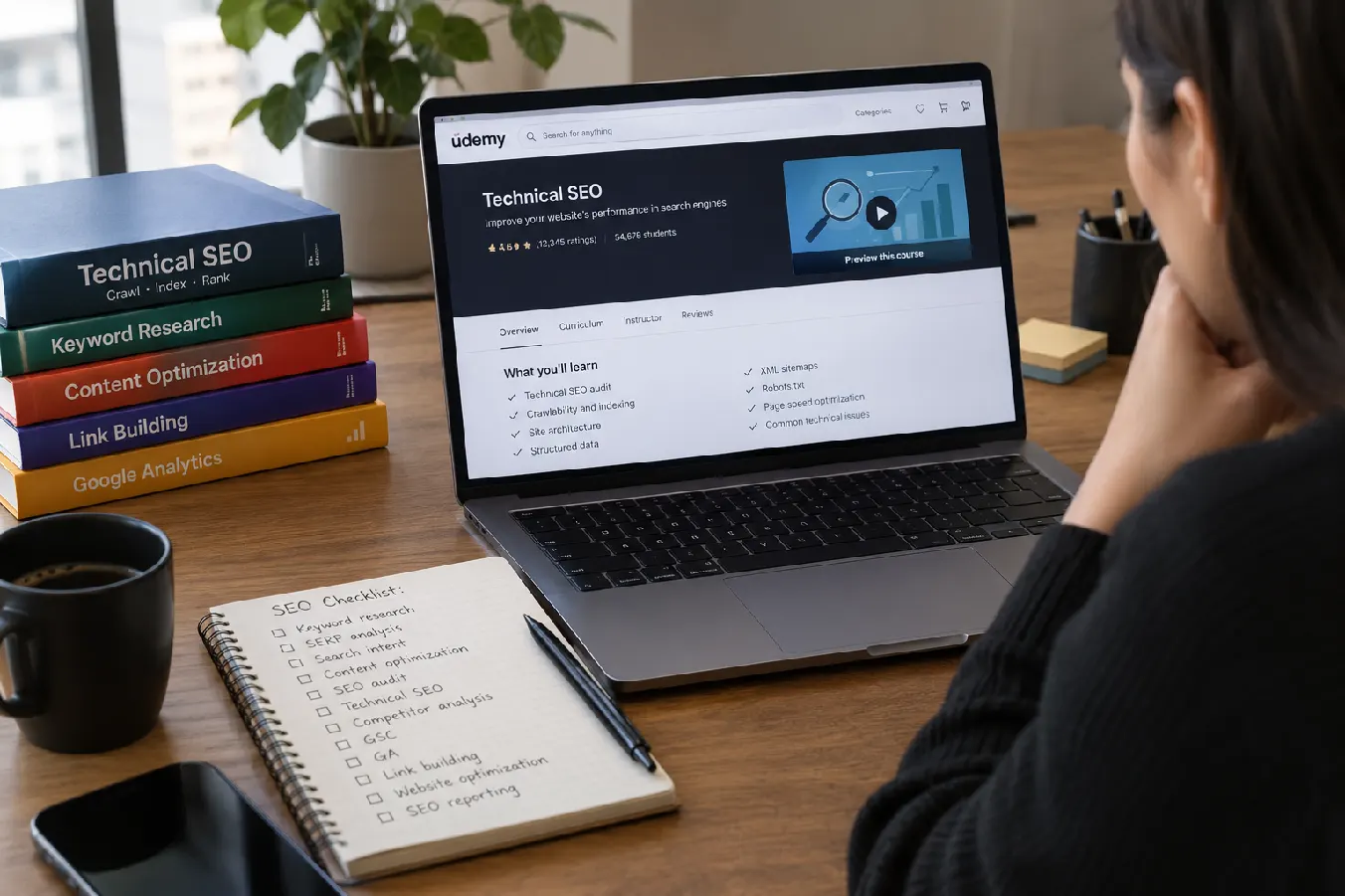
That can include:
- keyword research
- SERP analysis
- search intent
- content optimization
- SEO audits
- technical SEO
- competitor analysis
- Google Search Console
- Google Analytics
- link building
- website optimization
- SEO reporting
The strongest courses should ideally show you how those concepts are connected. This is also where Udemy’s sheer variety becomes useful.
The platform currently includes courses specifically focused on technical SEO and other hands-on SEO workflows rather than forcing everything into one broad program.
But there is an important warning.
Udemy’s variety is both its greatest advantage and one of its biggest weaknesses.
Because anyone who meets Udemy’s instructor requirements can build courses for the marketplace, quality varies considerably.
Some instructors are excellent practitioners.
Some are excellent teachers.
Some are both.
And some are neither.
That’s why I would never use the number of reviews or the length of a Udemy course as a substitute for actually evaluating its curriculum.
A 30-hour course isn’t automatically better than a 10-hour course. Sometimes the opposite is true.
Coursera Has a Major Advantage: Structured Learning
If there is one category in which I would choose Coursera without hesitation, it’s structured learning.
Imagine two learners.
The first says:
“I know nothing about SEO. Give me a logical path from beginner to competent.”
The second says:
“I already work in SEO. I want to become much better at technical SEO.”
I would not give them the same recommendation.
The first learner is an excellent candidate for Coursera.
The second is an excellent candidate for Udemy.
Coursera’s strongest programs are designed so that one course builds on another.
The UC Davis SEO Specialization explicitly recommends taking its courses in sequence, and the program concludes with a practical Capstone Project.
That is valuable.
A beginner doesn’t need to spend hours deciding whether they should learn keyword research before technical SEO, or whether they should start with content strategy or link building.
The curriculum designer has already made those decisions.
That’s a major benefit of a structured SEO course.
Which Is Better for Beginners?
Coursera.
This is one place where my overall preference for Udemy doesn’t change my recommendation. If you’re completely new to SEO and ask me:
“What’s the best platform for SEO courses for someone starting from zero?”
I would probably point you toward Coursera first. Beginners suffer from choice overload.
Search Udemy for “SEO” and you get hundreds of possibilities, each promising a different outcome. That sounds great until you realize that a beginner has no idea which curriculum is actually sensible.
Coursera’s curated programs reduce this problem.
Its current SEO catalog includes beginner-level programs, including UC Davis and IBM offerings, with structured progression and defined learning outcomes.
Udemy can absolutely teach a beginner SEO from scratch. But choosing the right Udemy course becomes much more important.
Which Is Better for Experienced SEO Professionals?
Udemy.
This is where I think the answer becomes much clearer.
Once you’ve worked with SEO for a while, you rarely need another course explaining what SEO is.
Your questions become more specific.
Maybe you want to improve your technical SEO auditing.
Maybe you want to understand JavaScript SEO.
Maybe you need better local SEO knowledge.
Local SEO is another area where specialized training can be useful, and I’ve compared several strong options for learning it.
Maybe you want to develop your ecommerce SEO skills.
Maybe your interest is AI SEO, GEO or AEO.
Maybe you want to become more advanced with Semrush or Ahrefs.
Maybe you’re trying to improve your content optimization process.
In those situations, I don’t necessarily want a long curriculum covering SEO fundamentals again.
I want a targeted course that solves my knowledge gap.
And that is where Udemy wins.
Coursera vs Udemy for Technical SEO
Technical SEO is a good example of why I don’t think one platform should simply be declared “better.”
Coursera is useful for understanding technical SEO as part of a larger SEO framework.
Udemy is particularly useful when you want to go deeper into a particular technical problem.
For example, an experienced SEO might want separate learning resources for:
Crawlability → indexing → canonicalization → redirects → XML sitemaps → structured data → JavaScript SEO → Core Web Vitals → technical auditing.
Trying to learn all of that from one general SEO course isn’t necessarily the best strategy.
With Udemy, you can construct your own specialization.
That’s a powerful advantage for experienced practitioners.
For a deeper look at specialized technical training, I’ve also compared several strong technical SEO course options.
What About AI SEO, AEO, GEO and AI Search?
This is another area where the old Udemy vs Coursera for SEO debate needs to be updated.
SEO education in 2026 cannot ignore AI search.
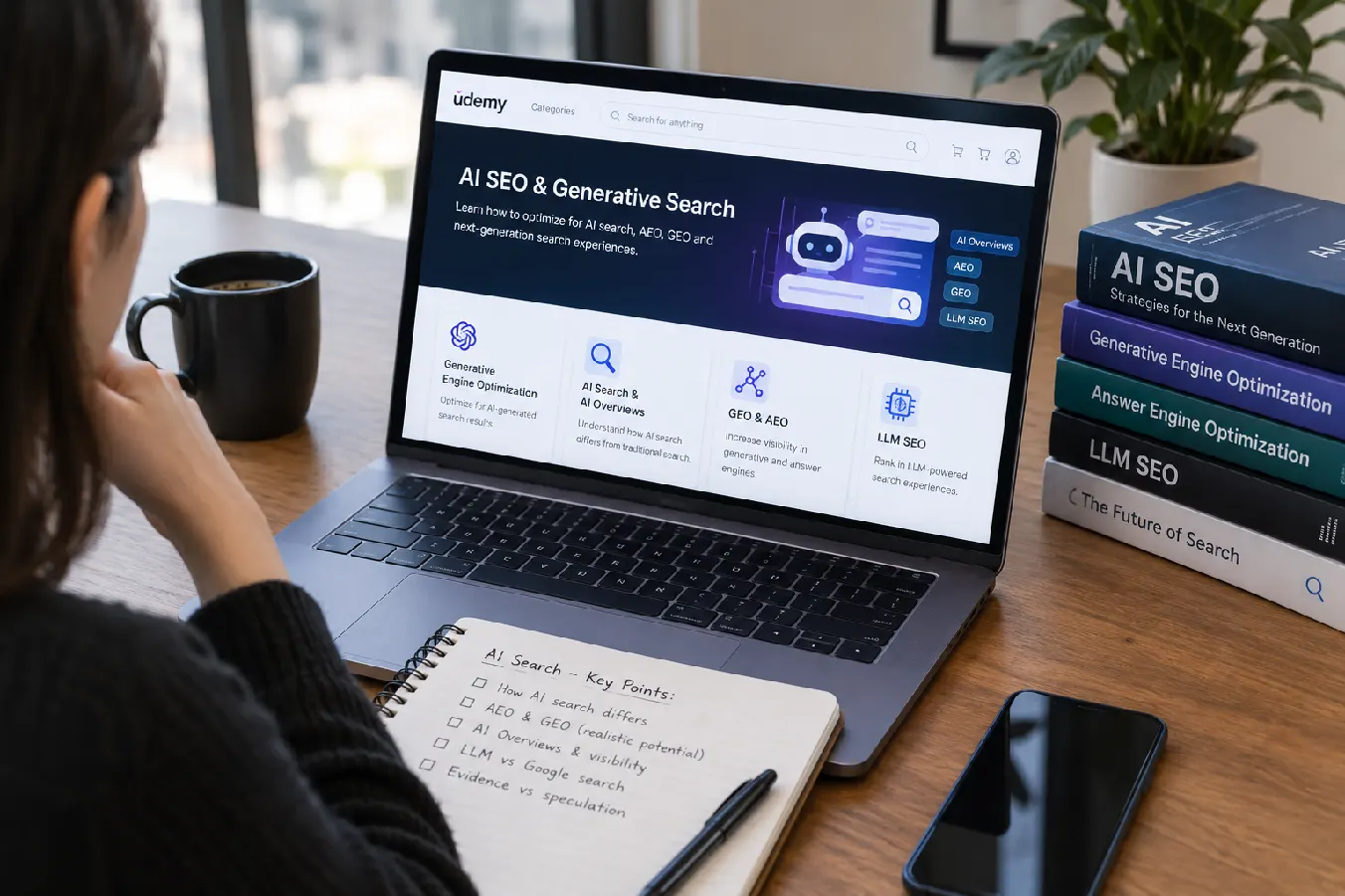
Courses increasingly discuss:
AI SEO, AEO, GEO, AI search, AI Overviews, LLM SEO, generative AI workflows and optimization for AI-generated search experiences.
Coursera is clearly moving in this direction. Its current SEO catalog includes programs covering Generative Engine Optimization, while its current listings also include newer programs positioned around AI SEO, GEO and related search technologies.
Udemy has moved rapidly in the same direction and has a very broad selection of courses covering AI-related SEO workflows. Its SEO catalog itself now highlights keeping up with the latest SEO techniques, alongside its large practical-course ecosystem.
In my view, Udemy currently has the advantage in breadth for AI SEO and related emerging topics.
But this is also the category where I would be most skeptical of marketing claims.
A course called “AI SEO 2026” isn’t automatically current just because the year is in the title.
The important question is whether the instructor actually understands:
- how AI search differs from traditional search,
- what AEO and GEO can realistically accomplish,
- how AI Overviews affect SEO visibility,
- where LLM-based search differs from Google Search,
- and which recommendations are evidence-based rather than speculation.
This is an area where course freshness and SEO course quality need to be evaluated separately.
Coursera vs Udemy Certificates: Which One Is Better?
Certificates are probably the most overrated factor in this entire comparison. Both platforms offer certificates, but they serve somewhat different purposes.
Coursera has a larger ecosystem of university- and company-backed credentials. Its current catalog includes credentials from institutions such as UC Davis and IBM, and Coursera explicitly positions its Professional Certificates around job-relevant skills and industry recognition.
Udemy’s individual paid courses provide certificates of completion, but Udemy explicitly says that it is not an accredited institution and that its certificates are not formal accreditation.
So if someone asks me:
“Coursera SEO certificate or Udemy SEO certificate?”
I’d give the credential-context advantage to Coursera.
But there’s another, much more important point.
Are Coursera certificates worth it?
Yes, to a degree.
A Coursera certificate can demonstrate that you completed a structured program and can be more meaningful when it is associated with a recognizable university or company.
But I would never confuse that with proof of SEO competence.
Are Udemy certificates worth it?
They’re useful as completion records, but I would place significantly less weight on them as career credentials.
That’s not an attack on Udemy.
It is simply the nature of the certificate.
Udemy itself describes its certificate as a certificate of completion, not an accredited professional certification.
And this aligns with what repeatedly comes up in learner discussions: people often want certificates for their resumes, but experienced respondents frequently point out that certificates from online learning platforms are not substitutes for demonstrable skills and real projects.
For SEO, I strongly agree with that distinction. If you asked me to choose between:
Three SEO certificates
and
One real website you’ve optimized, audited and grown
I’d take the second every time.
Coursera vs Udemy Pricing: Which Offers Better Value?
Pricing is another area where the platforms work differently.
Coursera is built heavily around individual courses, Specializations and subscriptions such as Coursera Plus. Its current pricing page lists individual learning options and Coursera Plus separately, with access and pricing varying according to the selected product and billing cycle.
Udemy lets learners purchase individual marketplace courses, and those purchases come with lifetime access to that course as long as the learner’s account remains in good standing and Udemy continues to license the course. It also offers a Personal Plan subscription.
Before paying for a course, it’s also worth looking at some of the strongest free SEO training available online.
That difference is important. If I want to complete an entire learning program, Coursera’s subscription model can make sense.
If I want one very specific SEO course and expect to return to it months later, Udemy’s individual-purchase model is extremely attractive.
For SEO professionals who know exactly what they want to learn, that’s a significant value advantage.
Self-Paced SEO Course: Coursera or Udemy?
Both are good choices for self-paced learning. Neither requires you to sit through a fixed classroom schedule.
But I think Udemy has a particularly strong use case here because of its individual-course model.
You can purchase a course, complete it at your own pace, and return to the material later. Udemy says individual marketplace-course purchases provide lifetime access, subject to the account and licensing conditions described in its policy.
That’s useful for SEO because some lessons are worth revisiting.
You might finish a technical SEO course today and return to its sections on indexing or JavaScript SEO six months later when you encounter a real client problem.
Coursera is also excellent for self-paced learning, particularly when you’re following a structured program.
So I wouldn’t make self-paced learning the deciding factor.
I’d make what you’re learning and how deeply you need to learn it the deciding factor.
Which Platform Has Better SEO Courses for a Career?
Again, I lean Udemy — but with a qualification.
Career value isn’t the same thing as certificate prestige.
For an SEO professional, career value comes from learning something you can actually use.
A course that teaches you how to conduct a technical SEO audit, interpret Search Console data, develop a content strategy, analyze a SERP, improve a website’s information architecture, or build a practical SEO workflow can be more valuable to your career than a highly recognizable certificate attached to shallow material.
That’s why I score practical learning and career value separately.
Best SEO Courses on Coursera vs Best SEO Courses on Udemy
One thing I’d strongly recommend is not treating the platform itself as the quality filter.
I’ve reviewed the best SEO courses on Coursera and the best SEO courses on Udemy separately, and the individual course matters enormously.
For that reason, I don’t need to pretend that every Udemy course is excellent.
Nor do I need to pretend that Coursera’s brand guarantees quality.
I can simply evaluate the actual course.
That’s a much more useful way to approach online education.
Which Is Better for Learning SEO in a Structured Way?
Coursera.
The structured learning model is more important when you don’t yet know how SEO fits together.
A good beginner needs a curriculum. You need to understand how:
search engines → crawling/indexing → keywords → search intent → content → on-page SEO → technical SEO → links → measurement
fit together.
That’s easier to accomplish through a coherent program.
Which Is Better for Learning Specific SEO Skills?
Udemy.
Once you understand the fundamentals, your knowledge gaps become narrower.
You’re less interested in:
“What is SEO?”
and more interested in:
“How do I solve this SEO problem?”
Udemy is exceptionally well suited to that style of learning.
Which Is the Best Platform to Learn SEO Overall?
After reviewing and comparing SEO courses from both platforms, I think the answer is:
Udemy.
Not because Coursera is weak.
And not because every Udemy SEO course is better than every Coursera SEO course.
Coursera has some meaningful strengths, particularly when it comes to structured learning, university and company-backed programs, and credential context.
But when I evaluate the platforms from the perspective of an SEO practitioner, I place more weight on practical learning, teaching quality, specialized training, flexibility, value and career usefulness.
That’s where I believe Udemy has the stronger overall proposition.
My Verdict: Coursera vs Udemy for SEO
After reviewing SEO courses across both platforms, my position is not that Udemy is universally better.
My position is more specific:
Udemy is the better overall choice for learning SEO, especially for learners who already understand the basics and want practical, specialized, flexible, and career-relevant training.
Coursera is the platform I would recommend to someone starting from zero who wants a structured SEO learning path.
Udemy is the platform I would recommend to someone who already knows SEO fundamentals and wants to develop specific skills.
And for professionals, that’s an important distinction.
SEO isn’t a subject where one curriculum is going to remain sufficient forever.
You might learn the fundamentals today.
Six months later, you may need technical SEO.
Then ecommerce SEO.
Then local SEO.
Then AI SEO.
Then GEO.
Then a new workflow involving AI search.
Your learning needs change.
Udemy’s biggest strength is that it lets your education change with them.
My final recommendations
Best overall for SEO: Udemy
Best for beginners: Coursera
Best for practical learning: Udemy
Best for a structured learning path: Coursera
Best for specialized SEO skills: Udemy
Best for technical SEO deep dives: Udemy
Best for certificate context: Coursera
Best for value when targeting a specific skill: Udemy
Best for AI SEO / AEO / GEO course variety: Udemy
Best for building a complete curriculum from scratch: Coursera
So when someone asks me “Coursera vs Udemy SEO — which one should I choose?”, my answer is simple:
Choose Coursera when you need a curriculum. Choose Udemy when you need a skill.
For most people who are serious about becoming better at SEO, I’d choose Udemy.
One Important 2026 Update: Coursera and Udemy Are Now One Company
There is one unusual detail anyone writing a Coursera vs Udemy SEO comparison in 2026 needs to acknowledge.
Coursera completed its combination with Udemy on May 11, 2026. The combined company now operates under Coursera, while the two learning platforms continue to exist as separate products as the companies work toward their longer-term integration.
That does not make this comparison irrelevant.
Quite the opposite.
For learners today, Coursera and Udemy still offer substantially different approaches to course discovery, curriculum structure, pricing, instructors and learning experiences.
But it means this is a comparison worth revisiting.
The combined company has said that the broader strategy is to bring together Coursera’s university and industry ecosystem with Udemy’s large instructor marketplace while developing more AI-powered and personalized learning experiences.
For SEO learners, that could eventually create a very interesting combination of structured credentials + practitioner-led learning.
For now, though, I would still evaluate the two platforms separately.
And if you’re not limited to Coursera or Udemy, I’ve also compared leading SEO learning options across different platforms.
Frequently Asked Questions
Is Coursera or Udemy better for SEO?
Udemy is my overall choice for SEO. Coursera is better for beginners who want a structured learning path, while Udemy is better for specialized, practical and targeted SEO training.
Is Coursera good for SEO?
Yes. Coursera has several strong SEO programs, including the UC Davis SEO Specialization and newer SEO programs covering areas such as GEO and AI-driven search.
Is Udemy good for SEO?
Yes, provided you choose your course carefully. Udemy has a very large SEO catalog covering fundamentals, technical SEO, local SEO, content, link building and emerging AI search topics.
Are Coursera certificates worth it?
They can be useful, particularly when the credential comes from a recognized university or company. But a certificate shouldn’t be confused with proof of SEO expertise.
Are Udemy certificates worth it?
They’re useful as certificates of completion, but they carry less credential weight than university- or company-backed professional credentials. Udemy itself states that it is not an accredited institution.
Which is better for a beginner SEO course?
I’d choose Coursera because the structured curriculum can make the learning path easier to follow.
Which is better for a practical SEO course?
I’d choose Udemy because of its strong selection of practical, hands-on and specialized SEO training.
Can you learn SEO completely on Udemy?
Yes. Udemy has enough SEO courses to build a complete learning path, but you’ll have to curate that path yourself. That’s both its strength and its weakness.
Is Coursera better than Udemy for technical SEO?
Not universally. Coursera is strong for learning technical SEO within a broader curriculum, while Udemy is particularly useful when you want specialized technical SEO training.
Which platform has better AI SEO courses?
I’d currently give Udemy the edge for breadth and specialization, although Coursera is rapidly expanding its AI SEO, GEO and related search offerings.
Which platform has better SEO courses overall?
Udemy is my overall pick, but the individual course still matters more than the platform name. I would evaluate the instructor, curriculum, practical work, update history, teaching quality and learner feedback before enrolling.