
A friend introduced me to SEO at a point when I knew very little about how search engines worked. I had heard of Google rankings, keywords, and website traffic, but I didn’t yet understand how those pieces came together or how the best SEO courses for beginners could help me turn that curiosity into practical skills.
I decided to give it a serious try. I spent two months studying an SEO course, learning unfamiliar terminology and trying to understand the basic principles behind search engine optimization. After those two months, I moved into an internship, where I could begin connecting what I’d studied with real work.
That transition taught me something important: learning SEO and actually doing SEO are two different experiences.
A course can explain keyword research, but choosing the right keywords for a real website requires judgment. You can learn what technical SEO means, yet still struggle when a site has indexing problems, complicated internal links, or conflicting technical recommendations.
That doesn’t mean you’re a bad learner. It means you’ve reached the point where theory needs to meet practice.
After eight years of working in SEO and digital marketing, I’ve reviewed a wide range of courses and learning resources. I’ve also seen how difficult it can be for newcomers to distinguish genuinely useful education from exaggerated promises, outdated tactics, and unnecessarily expensive training.
That’s why I approached this guide differently from a typical list of the best SEO courses for beginners. After eight years in SEO and digital marketing, I know that a course needs to do more than introduce terminology or promise better rankings. I compared each program’s published curriculum, lesson structure, format, price, certificate details, and available update information, then assessed how well its learning path prepares beginners for the decisions they will eventually face when working on real websites. I also considered each course’s limitations rather than treating every advertised feature as a proven strength.
Whether you’re looking for your first course, trying to learn SEO from scratch, or preparing for a career in digital marketing, you don’t have to know everything before you begin.
You need a reliable first step—and a realistic plan for what comes next.
The Best SEO Courses for Beginners at a Glance
The best SEO course for beginners isn’t necessarily the longest, most expensive, or most popular one. It depends on your current knowledge, budget, preferred learning style, and whether you want a quick introduction or a structured professional learning path.
These are the options I’d consider first when comparing SEO courses for beginners.
Quick Decision Guide
| Your Goal | Our Top Pick | Provider | Platform | Why |
|---|---|---|---|---|
| 🏆 Best overall free introduction | Ahrefs SEO Course for Beginners | Ahrefs | Ahrefs Academy | A concise, well-organized introduction to keyword research, on-page SEO, link building, and technical SEO basics. |
| Best for SEO fundamentals | Yoast Free SEO Course for Beginners | Yoast | Yoast SEO Academy | Explains how search engines discover, read, and understand websites, with short lessons, quizzes, and a certificate. |
| Best for practical, tool-guided learning | SEO Essentials with Semrush | Semrush | Semrush Academy | Connects foundational SEO concepts with tool demonstrations, keyword research, technical analysis, and introductory AI visibility. |
| Best structured learning path | Search Engine Optimization (SEO) Specialization | University of California, Davis | Coursera | A five-course program with assignments, a broader curriculum, and a hands-on capstone project. |
| Best comprehensive paid bundle | Reliablesoft Complete SEO Course | Reliablesoft | Reliablesoft Academy | Combines traditional SEO, keyword research, ecommerce SEO, analytics, and AI-focused training in one package. |
| Best for long-form video learning | SEO Training Masterclass 2026 on Udemy | Alex Genadinik | Udemy | Extensive video lessons covering multiple SEO disciplines, with a large learner base and a recently updated course listing. |
| Best quick SEO introduction | SEO Crash Course with Brian Dean | Semrush | Semrush Academy | A free, approximately 51-minute introduction to SEO, keywords, content, link building, and performance tracking. |
If you're ready to explore options beyond beginner-level training, check out our broader comparison of online SEO courses to compare more programs by curriculum, learning format, and overall value.
How I Selected These Beginner SEO Courses
Over eight years in SEO, I’ve learned that choosing a training program requires looking beyond its title, star rating, or position on another website’s list.
For this guide, I compared each course’s official description, published curriculum, lesson structure, pricing, certificate terms, student feedback, and available information about content updates. I assessed the programs against the same seven weighted criteria: Course Content & Curriculum, Practical Learning, Teaching Quality, Ease of Learning, Value for Money, Career Value, and Course Freshness. My experience working with SEO informed how I interpreted these factors—for example, whether a beginner is likely to gain a useful foundation or needs additional practice to apply the concepts on a real website. I based course-specific judgments on the information available for each program and treated undisclosed details as unknown rather than assuming they were strengths.
When evaluating the best beginner SEO courses, I focus on several questions.
Does the course genuinely accommodate beginners? A course may be labeled beginner-friendly SEO training, but that doesn’t necessarily mean someone with no previous knowledge can follow it comfortably. I look at whether the lessons establish the fundamentals before introducing more complicated concepts.
Does it teach transferable skills? Learning how a particular tool works can be valuable, but SEO knowledge shouldn’t depend entirely on one software platform. Beginners need to understand why a task matters, not merely where to click.
Does it provide practical learning opportunities? A hands-on SEO course can help learners connect theory with execution. Where possible, I favor training that uses examples, demonstrations, assignments, or a project rather than relying exclusively on explanations.
Is it an up-to-date SEO course? SEO changes, and educational materials need maintenance. I pay attention to current course information, the validity of the curriculum, and whether the teaching still makes sense for the way search works today.
Does the cost make sense? Some of the strongest introductory resources are free. Paid courses for beginners need to justify their cost with something meaningful, such as greater depth, structured assignments, instructor support, or a comprehensive learning path.
Finally, I consider the kind of learner a course serves best. Someone exploring SEO for the first time needs something different from a marketer preparing to manage campaigns professionally.
These criteria help me recommend courses based on actual learning value rather than simply repeating the names that appear on competing lists.
1. Ahrefs SEO Course for Beginners — Best Overall Free Introduction
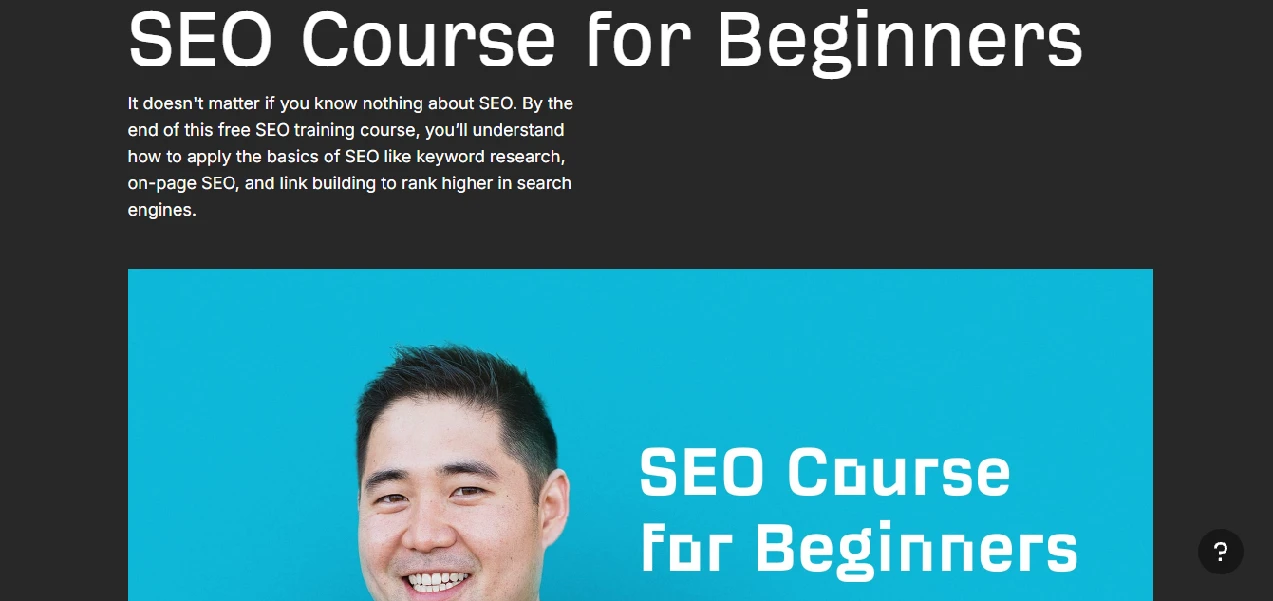
If you’re looking for a beginner SEO course that covers several essential topics without requiring a financial commitment, Ahrefs is one of my strongest recommendations.
The Ahrefs SEO Course for Beginners contains 14 lessons across five modules. It introduces SEO fundamentals, keyword research, on-page optimization, link building, and basic technical SEO. The course is free and doesn’t require registration.
At a Glance
Last reviewed: October 10, 2026
CoursesMag Expert Score
Score Breakdown
Why this score?
The curriculum covers the essential areas a newcomer needs to understand, including keyword research, on-page SEO, link building, and introductory technical SEO. Its main limitation is the depth available within a two-hour course.
Why this score?
The lessons explain tasks such as analyzing search intent, selecting keywords, optimizing pages, and assessing backlinks. These are actionable concepts, although learners still need a website and independent practice to develop confidence.
Why this score?
Ahrefs presents the material in short, digestible lessons led by Sam Oh. The structure suits learners who want clear explanations without a lengthy academic introduction.
Why this score?
The course explicitly accommodates people who know nothing about SEO, has no registration barrier, and can be completed in a short period. The pace may still require learners to revisit unfamiliar terms.
Why this score?
It is completely free and does not require sign-up. For a learner testing whether SEO interests them, the course offers excellent value without requiring a subscription or purchase.
Why this score?
The course introduces skills used in professional SEO work, but it does not provide a substantial project, advanced auditing experience, or a job-ready portfolio on its own.
Why this score?
The curriculum covers enduring SEO fundamentals and remains publicly available through Ahrefs Academy. The public course page does not clearly state a recent revision date, so the freshness score does not assume that every example has been recently updated.
Pros
- Free access without a registration requirement.
- Covers keyword research, on-page SEO, link building, and technical SEO basics.
- Short, beginner-friendly lessons.
- Useful as a first step before committing to a more comprehensive program.
Cons
- Limited depth because of the short duration.
- No certificate is advertised on the course page.
- Learners need additional practice to become comfortable with audits and real SEO decisions.
Community Score
Ratings from learners — on the source platform and from CoursesMag members.
Learner ratings on the source platform
No specific or citable ratings or reviews are available.
CoursesMag community rating
What makes it worth taking?
The main strength is its straightforward progression through important SEO concepts.
Instead of starting with complex technical details, the course establishes the basics and then introduces skills you’ll encounter when working on a website.
Ahrefs earns a strong overall score because it combines accessible teaching, useful fundamentals, and zero cost. It is best treated as a foundation, not a complete professional qualification.
Start the Free Ahrefs SEO CourseFor example, learning keyword research isn’t simply about identifying popular phrases. You also need to understand what searchers want, what type of content could satisfy their needs, and how to evaluate keyword opportunities.
Ahrefs introduces these ideas in a relatively concise format, making it useful for someone who wants a practical introduction before committing to a longer program.
Who should take it?
I’d recommend this course to complete beginners, small business owners, content marketers, and aspiring SEO specialists who want to understand the fundamentals before moving into more specialized training.
It can also work as the first step for people who want to learn SEO on their own without immediately paying for an SEO platform.
What are its limitations?
Two hours of training cannot cover every aspect of SEO in meaningful depth. You’ll still need to develop your ability to audit websites, interpret performance data, assess technical problems, and prioritize recommendations.
The course also uses examples connected to Ahrefs’ tools, so you’ll benefit from understanding the underlying SEO concepts rather than assuming you must use the same paid platform.
My take
For someone starting from zero, I see this as a sensible first step because it offers a short, free introduction to SEO fundamentals. Its biggest advantage is accessibility: beginners can build a basic understanding before committing to a longer program. I would treat it as a starting point, though, rather than a complete substitute for practicing keyword research, content optimization, and technical SEO on a real website.
2. Yoast Free SEO Course for Beginners — Best for Understanding SEO Fundamentals
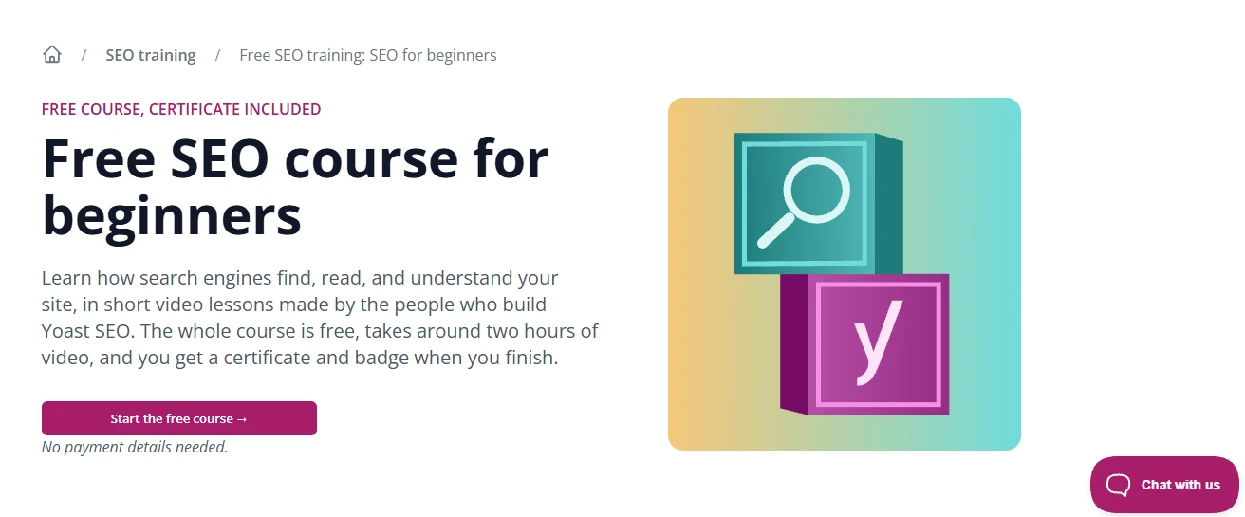
Some beginners find SEO confusing because they encounter dozens of tactics before understanding the basic mechanics of search engines.
Yoast approaches the learning process from a slightly different angle. Its free course explains how search engines discover, read, and understand website content before progressing through related optimization topics.
The course consists of 20 short video lessons and includes a certificate and badge after completion. No previous experience is required.
At a Glance
Last reviewed: October 10, 2026
CoursesMag Expert Score

Score Breakdown
Why this score?
The curriculum covers keyword basics, SEO copywriting, site structure, crawlability, and rich results. These are useful foundational concepts, though the course does not offer broad coverage of advanced strategy, link building, or analytics.
Why this score?
Short videos, quizzes, downloadable materials, and a cheat sheet help reinforce the lessons. However, the course is more focused on understanding the fundamentals than completing a substantial real-world SEO project.
Why this score?
Yoast's SEO and WordPress specialists create the lessons, supported by trained teachers. The emphasis on explaining how search engines work makes the course approachable for people with no previous experience.
Why this score?
The course starts from zero, divides material into 20 short videos, and includes quizzes and reference materials. Learners can progress without paying or purchasing a tool subscription.
Why this score?
The entire course is free, with a certificate and badge after completion. A free MyYoast account is required to save progress and issue the certificate.
Why this score?
The course helps learners understand foundational SEO concepts that are relevant to content and website roles. It does not, by itself, demonstrate the ability to manage a complete SEO campaign or conduct advanced analysis.
Why this score?
The course remains available through Yoast SEO Academy, with a clear focus on enduring SEO principles. The public course page does not provide a definitive recent revision date, so the score reflects the continuing relevance of its core curriculum rather than a verified full refresh in 2026.
Pros
- Free course with a certificate and badge.
- Excellent introduction to crawlability, site structure, and search engine fundamentals.
- Short lessons, quizzes, and downloadable learning materials.
- Suitable for learners using platforms other than WordPress.
Cons
- Limited hands-on work compared with project-based programs.
- Does not provide in-depth training in advanced SEO analysis.
- More extensive Yoast Academy training may require a premium membership.
Community Score
Ratings from learners — on the source platform and from CoursesMag members.
Learner ratings on the source platform
No specific or citable ratings or reviews are available.
CoursesMag community rating
What will you learn?
The curriculum covers SEO fundamentals for beginners, including:
How search engines find and understand pages.
Keyword selection and usage.
SEO copywriting and content readability.
Website structure and crawlability.
Rich results and related search features.
As an SEO basics course, Yoast is useful because it encourages you to understand why certain practices matter instead of treating SEO as a collection of rules to memorize.
For instance, knowing that a page needs to be discoverable and understandable by search engines helps you reason through problems involving internal links, site structure, and content organization.
Yoast stands out for explaining foundational SEO concepts in accessible language. It's especially useful for people who want to understand the mechanics of search before moving on to more tool-oriented training.
Start Yoast's Free SEO Course for BeginnersWho should take it?
This is a strong option for complete beginners, WordPress users, content writers, and people who want a clearer understanding of how SEO works before exploring individual tools.
Although Yoast is closely associated with WordPress, the fundamentals taught in the course are relevant to websites built on other platforms as well.
What should you know before enrolling?
The course provides a useful foundation, but it isn’t intended to replace advanced training in technical SEO, link acquisition, analytics, or complex content strategy.
If you want a beginner-friendly introduction focused on understanding the principles first, it deserves a place on your shortlist.
My take
I would consider Yoast for beginners who prefer a structured introduction to SEO concepts. Its beginner-focused format and completion badge can help learners organize their first steps, but a certificate alone does not demonstrate practical SEO ability. The best next step is to apply the concepts to a real page and see whether you can explain what needs improving and why.
3. SEO Essentials with Semrush — Best for Learning SEO Alongside Tools
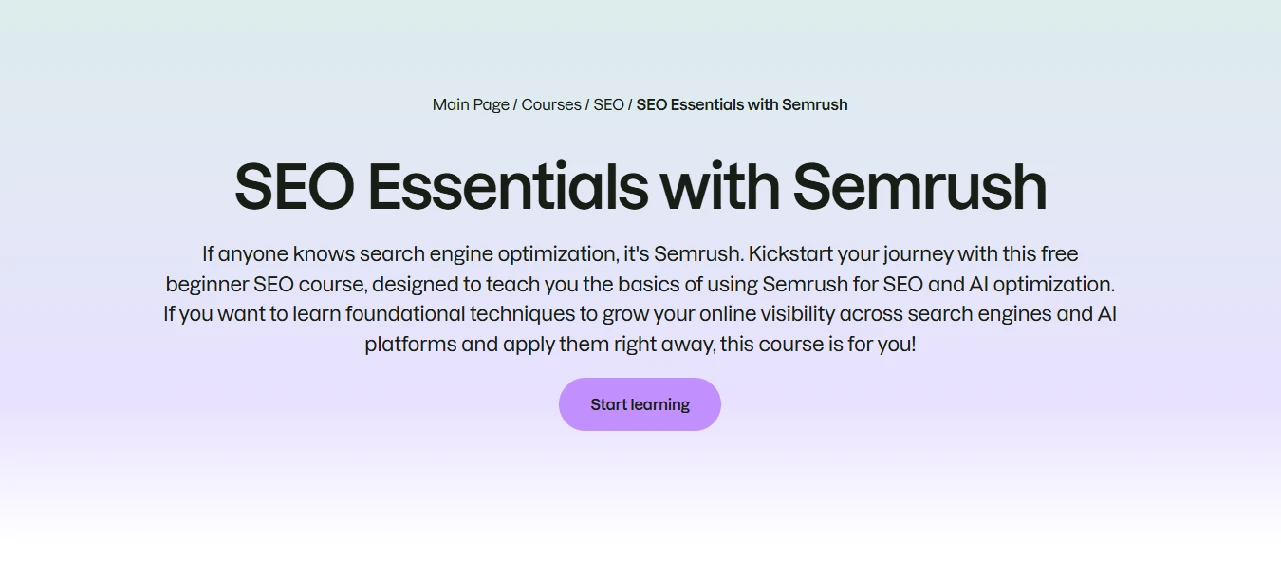
The Semrush Academy SEO course is particularly useful for people who want to learn SEO concepts while becoming familiar with an industry-standard SEO toolkit.
The current course covers keyword research, technical SEO, content optimization, backlink identification, and introductory AI visibility concepts. It also includes demonstrations of Semrush tools and offers a certificate through Semrush Academy.
At a Glance
Last reviewed: October 10, 2026
CoursesMag Expert Score
Score Breakdown
Why this score?
The current course introduces on-page, off-page, and technical SEO concepts alongside keyword research and AI visibility. Its strength is breadth across essential workflows, while its comparatively short lessons limit the depth of some topics.
Why this score?
Demonstrations and the accompanying beginner worksheet help learners connect concepts with site audits, competitor research, keyword selection, and backlink outreach. Some tasks depend on access to Semrush tools, however, so the training should be supplemented with tool-independent practice.
Why this score?
The lessons combine explanations from experienced Semrush practitioners with demonstrations of actual workflows. The separation between conceptual lessons and tool walkthroughs makes the subject easier to follow.
Why this score?
The course is designed for beginners, and the lessons are short. However, the account setup and tool-oriented exercises may feel less straightforward to someone who has never used an SEO platform.
Why this score?
The training and certificate are free, which makes the course a useful way to explore SEO tooling before committing to a paid subscription.
Why this score?
Familiarity with common SEO workflows can help beginners prepare for marketing and website optimization tasks. The course does not replace practical experience in diagnosing complex problems or developing a complete SEO strategy.
Why this score?
The current course includes an introduction to AI visibility, and the curriculum is available through Semrush Academy. This is a useful addition, though the course's tool-specific nature means some demonstrations may change as the platform evolves.
Pros
- Free training with a certificate.
- Combines SEO explanations with practical tool demonstrations.
- Includes an accompanying worksheet for initial SEO tasks.
- Covers foundational SEO and an introduction to AI visibility.
Cons
- Several workflows are tied to Semrush's toolkit.
- Some features may require account access or a paid subscription.
- The short course is not a substitute for advanced technical SEO or comprehensive campaign training.
Community Score
Ratings from learners — on the source platform and from CoursesMag members.
Learner ratings on the source platform
No specific or citable ratings or reviews are available.
CoursesMag community rating
Why I recommend it
There’s a difference between learning what an SEO task involves and understanding how to approach it in practice.
Keyword research provides a good example. You may understand the concept, but you’ll eventually need to evaluate search intent, compare opportunities, review competing pages, and decide which topics deserve attention.
Tool demonstrations can help bridge that gap by showing how research and analysis workflows operate.
The course is also relevant to beginners who want to understand how traditional SEO connects with current AI search visibility discussions without assuming that AI optimization replaces the SEO fundamentals.
Semrush is a strong choice for learners who prefer seeing SEO concepts applied in tool workflows. It is particularly useful after a purely conceptual introduction, but beginners should avoid confusing proficiency with a specific interface with broader SEO competence.
Start SEO Essentials with Semrush for FreeWho should take it?
I’d recommend this option to aspiring SEO specialists, marketers, and website owners who prefer visual demonstrations and want to develop practical familiarity with an SEO toolkit.
It’s a useful form of free SEO training for beginners because it lets you explore the concepts before deciding whether you need additional tool access.
What are its limitations?
Some lessons are tied closely to Semrush’s own interface and capabilities. Individual features may require a particular account or subscription, so you shouldn’t assume that every workflow will be available through free access.
My take
I like the idea of learning SEO concepts alongside the workflows used in an established SEO platform. This can help beginners understand how SEO tasks connect to the metrics and reports they may encounter at work. The limitation is that learners should not become dependent on tool-specific workflows: understanding search intent, content quality, and technical principles matters even when a paid tool is unavailable.
4. UC Davis SEO Specialization — Best for a Structured Learning Path
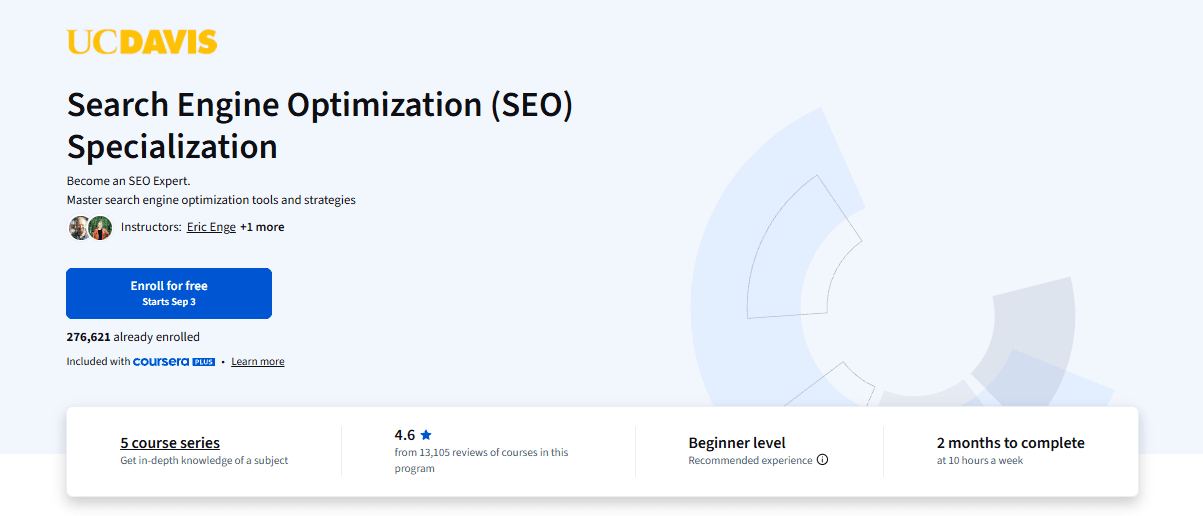
Not everyone learns well by collecting information from different sources. Some beginners prefer a sequence that explains what to learn first, what to learn next, and how the concepts connect.
The UC Davis SEO Specialization is designed around that type of learning.
The current Coursera listing identifies the specialization as beginner-level and consists of five courses. It recommends approximately two months at ten hours per week, while the university’s continuing education listing suggests that learners may take four to six months depending on their pace. The program concludes with a hands-on capstone project.
At a Glance
Last reviewed: October 10, 2026
CoursesMag Expert Score
Score Breakdown
Why this score?
The five-course sequence covers a broad range of SEO topics, including on-page and off-page optimization, audience research, competitor analysis, and reporting. The breadth makes it more comprehensive than a short introductory course.
Why this score?
Peer-reviewed and auto-graded assignments provide opportunities to apply concepts, while the capstone asks learners to complete a broader SEO consulting task and present recommendations.
Why this score?
The university-led structure, sequential lessons, assignments, and community discussion forums offer a more formal learning experience than a standalone video course.
Why this score?
Coursera classifies the specialization as beginner-level, but five courses require a substantial time commitment. Learners who are still exploring SEO may find the program more extensive than they need initially.
Why this score?
The program combines a structured curriculum, assignments, and a capstone. Its value depends on whether the learner needs that degree of structure; the full certificate pathway is not equivalent to the free introductory courses.
Why this score?
The curriculum includes audits, analysis, reporting, and presenting recommendations—activities that are relevant to agency, in-house, and consulting work. The capstone also provides an opportunity to demonstrate applied learning.
Why this score?
The specialization remains available and teaches enduring SEO skills. However, the public course description does not establish that every lesson has been updated to reflect the latest developments in AI search, so I would not treat it as a dedicated AI SEO program.
Pros
- Structured five-course curriculum.
- Assignments, discussion forums, and a practical capstone.
- Broad coverage of SEO strategy, optimization, analysis, and reporting.
- Strong public learner rating on Coursera.
Cons
- Requires more time than a short beginner course.
- Full certificate access involves payment under Coursera's current terms.
- Not all course content is necessarily focused on the latest AI search developments.
Community Score
Ratings from learners — on the source platform and from CoursesMag members.
Learner ratings on the source platform
CoursesMag community rating
What does it cover?
The specialization includes several areas of SEO:
On-page and off-page optimization.
Keyword and audience research.
Content and competitor analysis.
Local and international search considerations.
Website audits and SEO recommendations.
Applying knowledge through a final project.
The capstone matters because it encourages learners to bring different skills together. Instead of studying topics independently, you apply them to a more comprehensive SEO task.
UC Davis is my preferred option for someone who wants a sequence of connected courses and a substantial applied project. I'd recommend starting with a free course first if you're not yet sure whether SEO is a long-term goal.
Explore the UC Davis SEO Specialization on CourseraWho should take it?
I’d consider this course if you want a structured, in-depth learning experience and are willing to dedicate more time to developing your skills.
It can be particularly relevant if you’re preparing for a digital marketing role or want a more systematic foundation than a short introductory course can provide.
Is it worth paying for?
That depends on your goals and Coursera’s current enrollment options.
The specialization offers a clearer learning structure than many short courses, but not every beginner needs to start with a multi-course program. If you’re still discovering whether SEO interests you, I’d try a free course first.
My take
I would look at this option for beginners who want a more structured learning path rather than a short introductory course. Its multi-course format provides a clearer progression through SEO topics, which can be useful for learners who prefer guided study. The trade-off is the greater time commitment, so I would compare its current workload and cost with shorter alternatives before choosing it.
5. Reliablesoft Complete SEO Course — Best for Broad Coverage in One Bundle
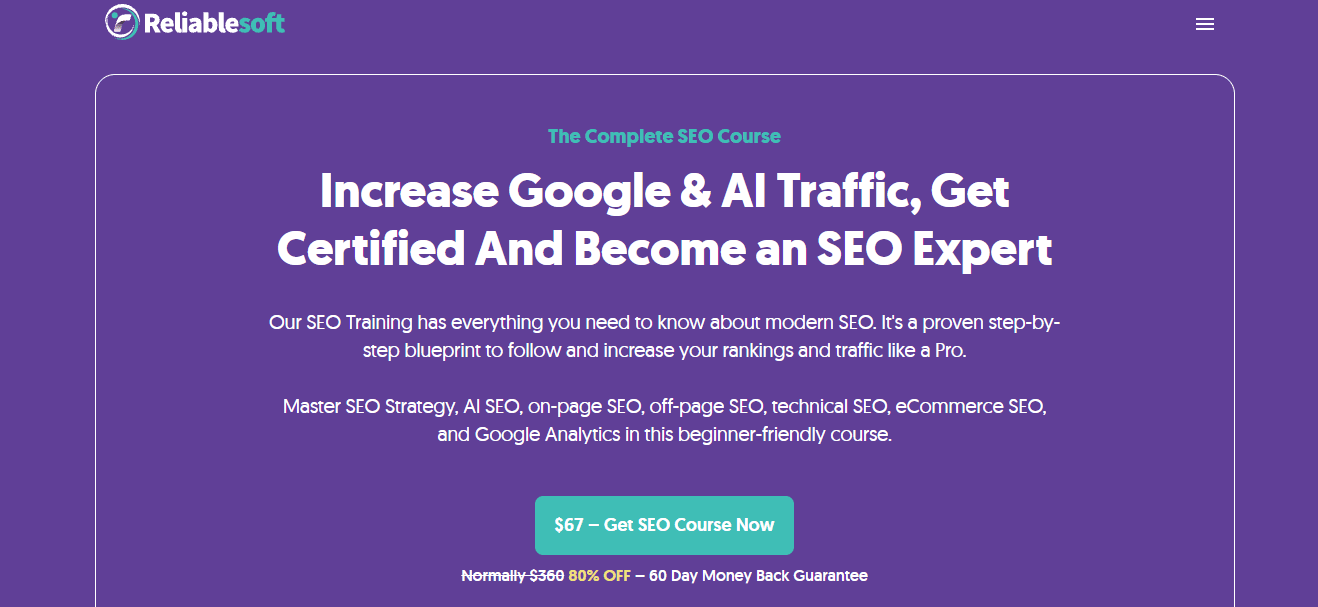
If you’re ready to invest in training, the Reliablesoft Complete SEO Course offers a broader package than a standalone introductory course.
The provider’s current bundle includes six courses and 49 lessons, covering SEO strategy, on-page and off-page optimization, technical SEO, keyword research, ecommerce SEO, Google Analytics, and AI SEO. The provider also advertises certification and lifetime course updates.
At a Glance
Last reviewed: October 10, 2026
CoursesMag Expert Score
Score Breakdown
Why this score?
The six-course bundle combines foundational SEO, keyword research, technical optimization, ecommerce SEO, analytics, and AI-focused training. This creates a broad learning package, although the depth of each individual topic varies across the bundle.
Why this score?
The provider advertises actionable lessons, downloadable course materials, and annotated screenshots. These can support implementation, although the public course information doesn't establish that every module includes a substantial independent project.
Why this score?
The step-by-step format and supporting materials are suited to self-paced learning. The assessment remains conservative because a provider's own marketing claims and testimonials are not equivalent to independently verified teaching-quality evidence.
Why this score?
The bundle is described as beginner-friendly and covers the subject through related courses. However, its larger scope means learners will need more time and discipline than they would for a two-hour introduction.
Why this score?
The advertised $360 offer provides access to six courses and a certification, making the price relatively accessible compared with many extended training programs.
Why this score?
Broader coverage of SEO, analytics, ecommerce, and AI-related topics can help learners build a more rounded foundation. The program should still be supplemented with actual website experience and independent analysis.
Why this score?
Reliablesoft labels the bundle as updated in September 2026 and advertises lifetime updates. This is a positive freshness signal, although a date alone cannot prove that every topic has been comprehensively revised.
Pros
- Six courses available in one bundle.
- Broad coverage of traditional SEO, ecommerce SEO, analytics, and AI-related topics.
- Includes an SEO certification and downloadable materials.
- Advertised lifetime access and lifetime updates.
Cons
- Requires a purchase, unlike several strong free alternatives.
- The current promotional price may change.
- The breadth of the bundle does not guarantee that every topic receives equal depth.
- The certification should not be confused with demonstrated professional competence.
Community Score
Ratings from learners — on the source platform and from CoursesMag members.
Learner ratings on the source platform
No specific or citable ratings or reviews are available.
CoursesMag community rating
Why consider it?
One advantage of a course bundle is that it brings several related learning areas together.
A beginner who wants to understand how SEO fits into broader website promotion may appreciate having keyword research, technical optimization, analytics, and ecommerce topics available in one package.
That doesn’t mean a bundle is automatically better than individual courses. The real question is whether its organization, explanations, and practical exercises justify the price.
Reliablesoft is worth considering for learners who want a broader curriculum in one purchase rather than several separate courses. Its value proposition is strongest when the current bundle price and the additional subjects are relevant to the learner's goals.
View Reliablesoft's Complete SEO Course BundleWho should take it?
I’d consider this option if you’ve already decided to pursue SEO and want a wider selection of lessons without assembling your entire learning plan from separate providers.
It may also suit small business owners or marketers who need to understand multiple aspects of organic search.
What should you check before buying?
Review the current course structure and any available previews. Look for detailed explanations, useful examples, and practical exercises rather than relying entirely on promises about traffic growth or certification.
The advertised price can change with promotional offers, so confirm the current cost before enrolling.
My take
The main appeal here is the broader training package: beginners can follow a more extensive learning path instead of piecing together several separate introductions. I would judge its value by how much of the bundle a learner actually needs, the quality of the published curriculum, and whether the practical material matches their goals. Before buying, check the current price and course details rather than relying on a previously advertised offer.
6. SEO Training Masterclass 2026 on Udemy — Best for Long-Form Video Learning
Some learners prefer a short course with a narrow focus. Others want a larger collection of lessons they can revisit over time.
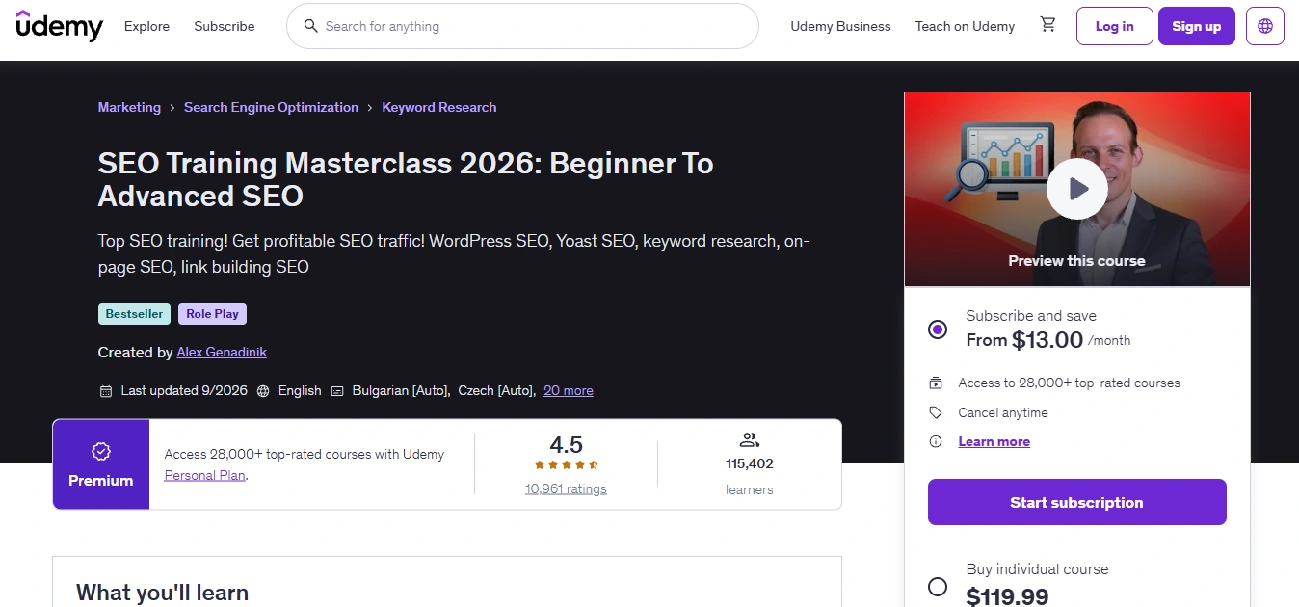
The SEO Training Masterclass 2026: Beginner to Advanced SEO is designed for people who prefer extensive video training.
Its current listing shows approximately 19 hours of content, with lessons covering keyword research, on-page SEO, link building, WordPress SEO, and related website optimization topics. The course was updated in September 2026, and its current rating and enrollment figures are available on the Udemy page.
At a Glance
Last reviewed: October 10, 2026
CoursesMag Expert Score
Score Breakdown
Why this score?
The course spans keyword research, on-page SEO, link building, WordPress, technical topics, and related optimization tasks. Its extensive coverage makes it useful as a reference library, but not every learner will need all the included subjects.
Why this score?
The course advertises examples, case studies, demonstrations, and instructor support. Learners can follow many tasks while watching, but the size of the course makes it important to practice instead of passively completing the videos.
Why this score?
The format offers a substantial amount of video instruction and a structured sequence of topics. However, the overall length and broad scope can make the learning experience feel less focused than that of a concise beginner-specific course.
Why this score?
Although the course includes beginner material, nearly 20 hours of training can feel overwhelming to someone who has never encountered SEO before. A shorter introductory course may be a better first step.
Why this score?
The course offers a large amount of video content within one purchase, and Udemy frequently changes promotional prices. Its value depends on how much of the curriculum the learner will actually use; compare the current price rather than relying on a generic list price.
Why this score?
The variety of subjects can help learners explore areas relevant to SEO roles. It does not, on its own, verify a learner's ability to produce results or independently manage a campaign.
Why this score?
Udemy's current listing identifies the course as updated in September 2026 and includes current-year SEO content. Beginners should still use official search-engine documentation to validate important technical recommendations.
Pros
- Extensive curriculum covering several SEO disciplines.
- A large number of learners and a public course rating.
- Includes case studies, demonstrations, and supplementary instruction.
- Useful for people who prefer to revisit long-form video lessons.
Cons
- The length may overwhelm someone who is completely new to SEO.
- Broad coverage doesn't guarantee equal depth in every discipline.
- A paid course with an advertised certificate does not replace real website experience.
- The course price can change with Udemy promotions.
Community Score
Ratings from learners — on the source platform and from CoursesMag members.
Learner ratings on the source platform
CoursesMag community rating
What makes it appealing?
The main attraction is its breadth. You can explore a variety of SEO tasks within one learning environment, instead of enrolling separately in several short programs.
That can be useful if you prefer learning through demonstrations and want to revisit lessons when you encounter a particular problem.
Udemy is a reasonable option for learners who like extensive video libraries and want to explore a variety of SEO topics. I would not automatically recommend it as the first step for every beginner; a short introductory course can make the larger curriculum easier to navigate.
Explore the SEO Training Masterclass on UdemyWho should take it?
I’d consider this option for learners who are comfortable with long-form video instruction and want a substantial library of material.
It can also appeal to people who want to explore how SEO applies across different website platforms.
The limitation to keep in mind
A large number of lessons doesn’t automatically produce a better learning outcome.
If you simply watch one video after another without implementing the techniques, you can finish a long course while still feeling uncertain about how to work on a real website.
Try to apply the lessons as you progress rather than treating course completion as the goal.
My take
This may suit learners who prefer a broad course covering multiple stages of SEO in one place. The advantage is having a more extensive set of lessons to work through; the potential drawback is that beginners can feel overwhelmed if they try to absorb everything at once. I would start with the foundational sections and look for opportunities to apply each concept before moving to more advanced topics.
Before enrolling, compare this program with other options in our comparison of SEO courses on Udemy.
7. SEO Crash Course with Brian Dean — Best for a Quick Start
If you’re overwhelmed by the volume of information available about SEO, a short course can help you get started without feeling that you need to master everything immediately.
The SEO Crash Course with Brian Dean covers introductory SEO concepts, keyword research, content, link building, and tracking results across seven lessons. Semrush Academy offers a certificate for completing the course.
At a Glance
Last reviewed: October 10, 2026
CoursesMag Expert Score
Score Breakdown
Why this score?
The course introduces several important activities in SEO, including keyword research, content creation, link building, and tracking results. Its short duration limits the detail available for more complex concepts.
Why this score?
The lessons explain actionable steps, and the curriculum encourages learners to begin optimizing a website. However, a 51-minute course cannot provide the depth of practice or independent project work found in longer programs.
Why this score?
Brian Dean's focused instruction gives learners a concise framework for understanding essential SEO activities. The short format keeps the introduction accessible, although it necessarily leaves many questions for further study.
Why this score?
The course requires a relatively small time commitment and starts with introductory material. It is a particularly manageable option for learners who are unsure where to begin.
Why this score?
The course is free and includes a completion certificate. It is a low-risk way to explore the fundamentals before deciding whether a longer course is worth purchasing.
Why this score?
It introduces relevant professional tasks, but the content is too short to establish job-ready skills or demonstrate a learner's ability to manage an SEO campaign independently.
Why this score?
The course remains available in Semrush Academy and focuses on foundational activities that retain their value over time. Its focus is introductory rather than a comprehensive review of emerging AI search workflows.
Pros
- Free training with a certificate.
- Short enough to complete without a major time commitment.
- Covers several essential SEO activities in a logical sequence.
- Useful for learners who want an introduction before choosing a more comprehensive course.
Cons
- Limited depth because of the short duration.
- No comprehensive practical project.
- Insufficient on its own for learning technical SEO, advanced analytics, or full SEO strategy.
Community Score
Ratings from learners — on the source platform and from CoursesMag members.
Learner ratings on the source platform
No specific or citable ratings or reviews are available.
CoursesMag community rating
Why include such a short course?
A beginner doesn’t always need a comprehensive program on the first day.
Sometimes you need a simple overview that shows you the main activities involved in SEO before deciding which areas deserve more attention.
This course offers that kind of starting point.
This course is best understood as a quick orientation to SEO rather than a complete training program. For someone who feels overwhelmed by the subject, it can make the first step easier; the next step should be a more detailed course and practical work.
Start Brian Dean's Free SEO Crash CourseWho should take it?
I’d recommend it to someone who wants a brief introduction before moving into longer training. It can also serve as a refresher for people who understand the basics but want to revisit a straightforward SEO workflow.
What won’t it teach you?
A course of this length won’t provide deep coverage of technical SEO, content strategy, analytics, and comprehensive website audits.
Treat it as an introduction, not a complete substitute for more detailed training.
My take
I would use this as a low-commitment introduction for someone who wants an overview before deciding how much time to invest in SEO. Its short duration is an advantage for getting started, but it also means learners should not expect it to provide the depth of a full SEO learning path. The certificate is a useful completion record, while practical ability still has to come from applying what was learned.
Free vs. Paid SEO Courses for Beginners: Which Should You Choose?
You don’t need to pay for your first course to begin learning SEO.
High-quality free SEO courses for beginners, including Ahrefs, Yoast, and Semrush Academy, can introduce the fundamentals and help you decide whether you want to continue.
If budget is your primary concern, see our dedicated guide to the best free SEO courses for beginners. I've kept that comparison separate because choosing a course based on cost is a different decision from choosing the best course for your learning needs.
Paid SEO courses for beginners can be worth considering when they offer benefits you genuinely need, such as a comprehensive learning path, structured assignments, instructor feedback, practical projects, or deeper specialization.
Before spending money, ask yourself:
Does the curriculum cover skills I actually need?
Does the course include practical work?
Can I preview the instructor’s teaching style?
Is the content maintained and relevant?
Would a free course give me a sufficient foundation for now?
My own path into SEO taught me not to judge a course by its price or certificate alone. Studying a course helped me build a foundation, but my first internship showed me that practical skills develop through applying those concepts to real websites. For beginners, free training can be enough to get started; a paid program is worth considering when it closes a specific learning gap through a more structured curriculum, deeper instruction, or meaningful practical exercises.
The goal isn’t to buy the most expensive education available. It’s to choose the training that best matches your current situation.
How to Learn SEO From Scratch: A Practical Learning Path
If you’re wondering how to start learning SEO, I would avoid trying to master every discipline at the same time.
A clear SEO learning path for beginners can help you understand what to study first and how to progress from theory to practical work.
If you want to specialize in online stores, explore our guide to the best ecommerce SEO courses in 2026 to learn how to optimize product pages, category pages, and ecommerce websites for search.
1. Begin with SEO fundamentals for beginners
Start by understanding how search engines discover, crawl, and index web pages.
You should also learn what search intent means, why content relevance matters, and how search engines help people discover useful information.
The Google SEO Starter Guide is a valuable reference alongside your course. It explains foundational practices for helping search engines understand content and helping users discover relevant pages.
For additional guidance from Google's ecosystem, see our review of Google's SEO learning resources.
2. Learn keyword research and on-page optimization
Next, learn to identify the questions your audience is asking and understand what users expect to find when they search.
Practice reviewing related keywords, assessing search intent, organizing pages, and writing descriptive titles and headings.
The objective isn’t to repeat keywords as often as possible. It’s to create content that addresses a specific user need clearly and thoroughly.
3. Understand technical SEO and link building
Once you understand the fundamentals, start learning about site structure, crawlability, internal linking, indexing, and backlinks.
You don’t need to become a developer before learning technical SEO. Begin by understanding common issues and how to investigate them, then build your implementation skills gradually.
Link building requires the same kind of thoughtful approach. Learn how links contribute to discovery and authority, and how to evaluate relevance and quality before attempting to acquire them.
4. Practice on a real website
A course can explain what to do, but a website gives you an opportunity to investigate problems and see how your decisions affect real pages.
This is one theme that regularly appears in discussions within the SEO community. In the self-taught SEO discussion on Reddit, beginners ask how to develop their skills, which resources to trust, and whether they need paid tools before they get started. Other discussions emphasize practical testing rather than trusting every technique presented in a course.
I agree with the underlying principle: learning becomes much more useful when you can apply it.
I felt this gap myself when I was starting in SEO. I spent two months studying my first SEO course before moving into an internship. That transition helped me understand that learning SEO terminology and principles is only the beginning; applying them in real work requires judgment, context, and practice. A course can explain how SEO works, but working on actual websites is where you begin to understand how to apply those concepts to a particular situation. That experience is one reason I look beyond course completion and certificates when evaluating SEO training for beginners.
Start with a personal website, a small project, or a site you already manage. Make a change, record what you did, and monitor the results.
Google Search Console is especially useful for beginners because it provides information about search queries, impressions, clicks, indexing, and other aspects of website performance.
Not every change will improve rankings immediately. That’s part of the learning process. Your goal is to become better at investigating problems, forming hypotheses, and evaluating evidence.
5. Continue with a beginner SEO roadmap
Once you’ve developed the basics, you can use LearningSEO.io to identify the next areas you want to study.
Its free roadmap organizes learning resources across topics such as keyword research, content optimization, technical SEO, link building, and more specialized areas.
Use it as a guide rather than another list you must finish from beginning to end. Learn the fundamentals first, then focus on the topics most relevant to your goals.
If your long-term ambition is to understand how to become an SEO specialist, build practical experience alongside your education. Over time, you’ll need to develop not only technical knowledge but also analytical judgment and the ability to communicate recommendations effectively.
Online SEO Courses for Beginners: How to Evaluate Them
There are many best online SEO courses for beginners, but finding one that fits your needs requires more than comparing star ratings.
Before enrolling in an online SEO course for beginners, look at four things.
First, check the prerequisites. An SEO course for complete beginners should explain unfamiliar concepts rather than assume you already understand them. If you want an SEO course with no experience required, look for a clear statement of the intended audience and a curriculum that begins with foundational topics.
Second, review the practical work. A hands-on SEO course should help you apply concepts through demonstrations, exercises, or assignments. A course with real-world projects can be especially helpful, provided the tasks are relevant and sufficiently explained.
Third, check the freshness of the material. A course doesn’t become obsolete simply because it isn’t brand new, but the provider should maintain information that depends on changing tools, workflows, and search features. Look for evidence that the course remains useful as an up-to-date SEO course.
Finally, consider the learning format. Some people benefit from short videos, while others prefer a structured program with assignments. The best beginner-friendly SEO course is the one whose teaching style helps you understand and apply its material—not necessarily the one with the most impressive marketing.
SEO Courses With Certificates: Are They Worth It?
Many learners search for SEO courses with certificates because they want to demonstrate their effort or strengthen a résumé.
If earning a certificate is one of your priorities, explore our guide to the best SEO courses with certificates in 2026, which compares free and paid programs and explains what each credential offers.
A beginner SEO certification can be useful, particularly when you’re starting your career and want to show that you’ve completed a structured learning program. However, a certificate by itself doesn’t demonstrate that you can solve SEO problems or deliver results.
When comparing an SEO course with certificate for beginners, check whether the program includes meaningful assessments, practical exercises, or a project rather than treating the credential as the main benefit.
For example, the UC Davis specialization includes a capstone, while Yoast and Semrush Academy offer certificates upon course completion. These credentials serve different purposes, so evaluate them in the context of the curriculum and your goals.
SEO Course vs. Self-Learning: Which Is Better?
The choice between an SEO course vs self-learning isn’t necessarily either-or.
A course can provide structure and help you avoid missing important fundamentals. Self-directed learning gives you flexibility to investigate topics and solve problems as they arise.
If you want to learn SEO on your own, I’d still recommend beginning with a structured course or the Google documentation. Then supplement that foundation with real-world practice, reliable articles, and specific learning goals.
There is no need to choose between spending months watching courses and trying to figure everything out independently. A combination of structured education and practical experimentation is often more useful.
Do You Need SEO Tools to Get Started?
You can begin learning with free SEO tools for beginners and educational resources. You don’t need to purchase every subscription as soon as you discover that a tool exists.
Google Search Console can help you examine your site’s search performance, while free training from Ahrefs, Yoast, and Semrush Academy can introduce common SEO workflows.
If your goal is to learn SEO without paid tools, start with the resources available to you and focus on understanding the underlying concepts. You can explore paid products later if you find that you need their specific capabilities.
Frequently Asked Questions
Can I learn SEO for free?
Yes. You can learn SEO fundamentals using free courses, official documentation, and practical exercises. Ahrefs, Yoast, Semrush Academy, and the Google SEO Starter Guide are useful starting points. If you eventually need more structure or specialized training, you can explore paid courses later.
Do I need Ahrefs or Semrush to learn SEO?
No. You can start learning without a paid subscription to either platform. Their free educational resources can help you understand the basics, while Google Search Console gives you a way to investigate your website’s search performance. Paid tools may become useful when your projects require more extensive research or analysis.
Do I need a website to practice SEO?
You can understand introductory concepts without owning a website, but having one is extremely helpful for practice. A personal blog or small project provides an opportunity to optimize pages, investigate indexing, review search queries, and evaluate changes over time.
How long does it take to learn SEO?
You can learn some fundamentals in a few hours or days, but developing practical skills takes longer. Your progress depends on your starting point, study schedule, and opportunities to work on real websites. Be cautious of courses that promise professional expertise or guaranteed rankings after a few lessons.
Are SEO courses worth it?
Yes, when a course provides reliable information, a useful learning structure, and opportunities to develop practical skills. A course cannot guarantee rankings, traffic, or employment, but it can help you build a foundation and learn how to approach SEO tasks more systematically.
Does an SEO certificate matter?
A certificate can demonstrate that you’ve completed a learning program, but it isn’t a substitute for practical ability. If you’re preparing for a role in SEO, combine your training with examples of keyword research, content optimization, technical investigations, or projects you’ve worked on.
How should I choose an SEO course with no previous experience?
Start by reviewing the prerequisites and curriculum. Choose a course that introduces SEO fundamentals before moving into more advanced topics, and look for examples or assignments that help you apply what you learn. If you’re uncertain about your commitment, start with a free course before paying for a more extensive program.
How do I choose between free and paid SEO training for beginners?
Free courses are often enough to establish the basics. Paid training may be worthwhile if it provides deeper coverage, a structured curriculum, instructor feedback, or meaningful projects. Compare the actual educational value rather than assuming that a higher price means a better course.
Final Thoughts: Start With One Good Course and Keep Practicing
Learning SEO can be intimidating at first. There are unfamiliar terms to understand, many competing recommendations, and no shortage of people promising quick results.
But you don’t have to learn everything before you begin.
After eight years in SEO and digital marketing, my recommendation is to choose a course that gives you a clear foundation, then put what you learn into practice as early as possible. You do not need to master every SEO concept before getting started, and you do not need an expensive certificate to begin learning. What matters is building a sound understanding of the fundamentals and gradually learning how to apply them to real websites. A good beginner course should make that next step clearer, not make you feel that completing lessons is the finish line.
For most people starting from zero, Ahrefs or Yoast is a sensible first choice. Semrush can help you become familiar with practical tools, while the UC Davis specialization or a broader paid program may be more appropriate once you’re ready for deeper study.
The best SEO course for beginners is the one that meets you at your current level and helps you progress toward your goals. You don’t need a collection of certificates or an expensive toolkit to begin building that foundation.
Start with one good resource, give yourself time to understand it, and practice consistently. That’s how you move from feeling overwhelmed by SEO to gradually becoming confident in your ability to use it.