
SEO is already a specialized discipline, but SEO for ecommerce websites is even more specialized and often comes with significantly greater technical challenges. A general SEO course online may teach you keyword research, content optimization, and link building, yet still leave you unprepared for the problems that arise when optimizing thousands of products, category pages, filters, and product variations.
That is why choosing one of the best ecommerce SEO courses in 2026 requires more than finding a popular training program. You need an ecommerce SEO strategy that accounts for how shoppers search, how search engines crawl your store, and how product and category pages attract visitors who are ready to buy.
The right ecommerce SEO training can help you build these skills, whether you run a Shopify store, manage a WooCommerce website, or work as an SEO professional for multiple retailers. However, not every ecommerce SEO course provides the same depth. Some offer a comprehensive curriculum, others focus on advanced technical SEO, and a few specialize in a single skill, such as internal linking or link acquisition.
I compared seven options based on their actual curricula, practical exercises, cost, accessibility, and relevance to online stores. I also considered recommendations and learning experiences shared by SEO practitioners on Reddit rather than ranking courses simply because they appear on multiple lists.
Quick Decision Guide
| Your Goal | Our Top Pick | Provider | Platform | Why |
|---|---|---|---|---|
| Best Overall Ecommerce SEO Course | Yoast Ecommerce SEO Course | Yoast | Yoast Academy | Comprehensive training covering product pages, site structure, technical SEO, and structured data. |
| Best Ecommerce SEO Course for Beginners | Reliablesoft Ecommerce SEO Course | Reliablesoft | Reliablesoft Academy | Nine structured lessons on keyword research, product and category pages, content, and link building. |
| Best Practical Ecommerce SEO Bootcamp | Ecommerce SEO Bootcamp | Freddie Chatt | Freddie Chatt Website | 18 focused lessons on commercial keywords, money pages, content strategy, and link acquisition. |
| Best Free Comprehensive Ecommerce SEO Course | SearchBlueprint E-commerce SEO Academy | SearchBlueprint | SearchBlueprint Academy | 27 free lessons covering product SEO, technical issues, Shopping visibility, and measurement. |
| Best for Technical Ecommerce SEO | Rankar Academy E-Commerce SEO | Rankar Academy | Rankar Academy | Covers faceted navigation, crawl waste, product variants, and structured data. |
| Best Project-Based Ecommerce SEO Course | PINSEO Ecommerce SEO Course for Sales | PINSEO Academy | PINSEO Academy | Includes a practical store project, implementation workbook, and editable worksheets. |
| Best Free Ecommerce Internal Linking Course | How to Boost E-Commerce SEO with Internal Linking | Semrush | Semrush Academy | Free certificate training on product links, category navigation, canonicals, and pagination. |
1. Yoast Ecommerce SEO Course
Best Overall
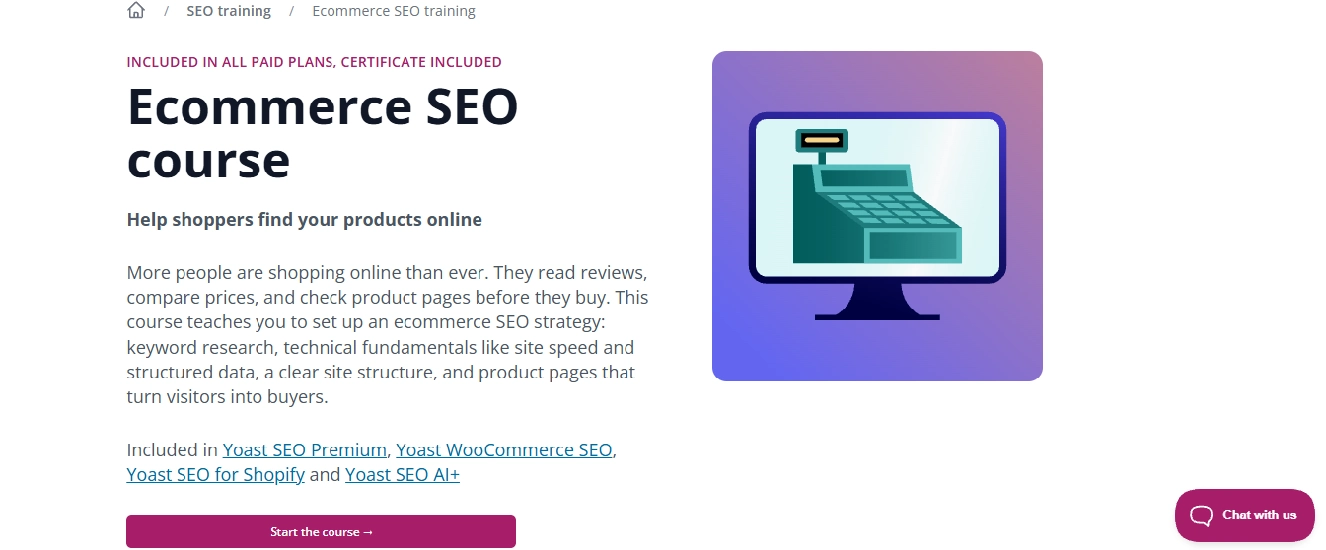
The Yoast Ecommerce SEO Course is my first choice for readers who want a broad understanding of SEO specifically for online stores. Rather than concentrating on one isolated skill, it covers the main areas that an ecommerce SEO strategy needs to address.
At a Glance
Last reviewed: October 16, 2026
CoursesMag Expert Score
Score Breakdown
Why this score?
Covers keyword research, product pages, site structure, speed, and structured data.
Why this score?
Includes examples, quizzes, PDFs, and an ecommerce SEO checklist.
Why this score?
Lessons are created by Yoast SEO and WordPress specialists.
Why this score?
Starts with fundamentals and organizes the subject into clear modules.
Why this score?
Offers broad coverage, but access requires an eligible paid plan.
Why this score?
Develops relevant ecommerce SEO skills and provides a completion certificate.
Why this score?
Yoast says the course is updated as SEO practices change.
Pros
- Comprehensive ecommerce SEO curriculum
- Includes a certificate and practical resources
- Covers product pages, site structure, and technical fundamentals
- Applicable to different ecommerce platforms
Cons
- Requires an eligible paid plan
- Advanced enterprise technical SEO is not its main focus
- Shopify-specific training is relatively limited in this course
Community Score
Ratings from learners — on the source platform and from CoursesMag members.
Learner ratings on the source platform
No specific or citable ratings or reviews are available.
CoursesMag community rating
The curriculum includes 26 video lessons across nine modules, eight mandatory and one optional. It covers keyword research, technical SEO fundamentals, site structure, product pages, site speed, structured data, and mobile optimization. The course is included in eligible paid Yoast plans and comes with a certificate. It is designed for different store types, including WooCommerce and Shopify.
To view the course content and current access options, visit Yoast's official page.
View Official CourseWhat makes this course valuable?
A useful ecommerce SEO course should explain how the different parts of a store work together. For example, improving an individual product page is only part of the process. You also need a logical category hierarchy, internal links that help shoppers and search engines discover products, and technical settings that prevent unnecessary URLs from being indexed.
Yoast provides a structured introduction to these areas. It is a reasonable starting point for someone who understands basic SEO but needs to learn how to apply it to an online shop.
Main strengths
Covers the major areas of ecommerce SEO in one curriculum.
Includes practical topics such as product optimization, site structure, speed, and structured data.
Offers a completion certificate.
Applies to WooCommerce, Shopify, and other store types.
Limitations
The course is tied to Yoast’s paid plans, so the total cost depends on the plan you choose. It also should not be treated as a substitute for advanced training in large-scale crawling, complex faceted navigation, or custom ecommerce architectures.
Best for
Store owners and marketers looking for comprehensive ecommerce SEO training without starting with highly technical material.
2. Reliablesoft Ecommerce SEO Course
Best for Beginners
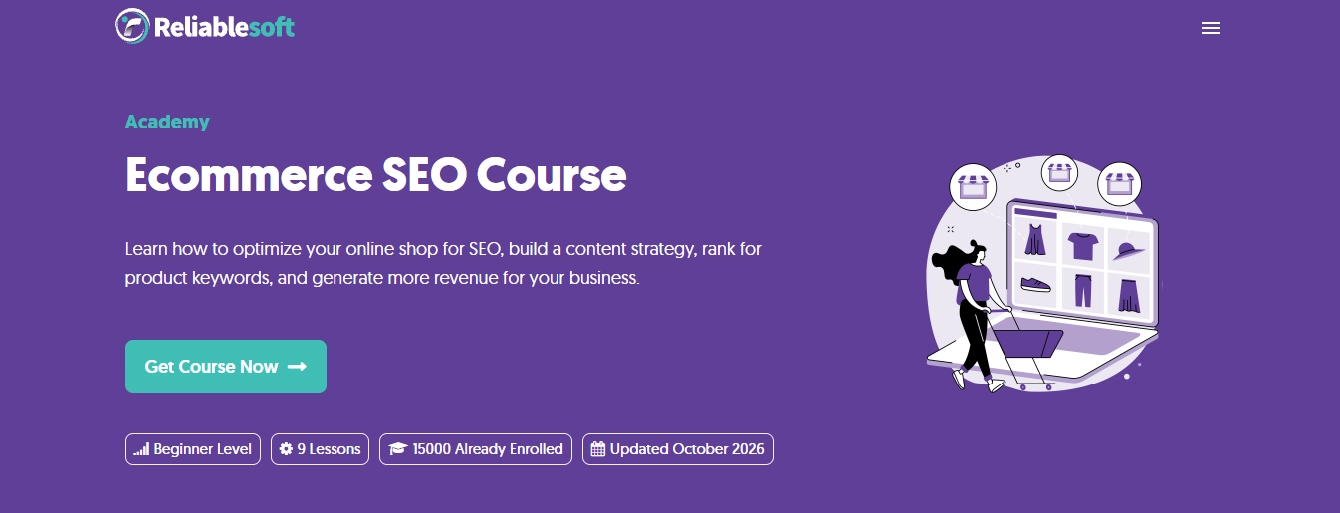
Reliablesoft is another strong option for readers who want a structured learning path. Its ecommerce SEO course focuses on the practical requirements of improving an online shop, from researching product keywords to optimizing category pages and developing a content strategy.
At a Glance
Last reviewed: October 16, 2026
CoursesMag Expert Score
Score Breakdown
Why this score?
Covers the core ecommerce SEO workflow, including product and category optimization.
Why this score?
Focuses on applied keyword research, site structure, content, and links.
Why this score?
Clear lesson structure and positive learner testimonials support this assessment.
Why this score?
Designed for beginners without requiring advanced technical experience.
Why this score?
Offers ecommerce training within a broader digital marketing bundle.
Why this score?
Builds relevant SEO skills and offers certification opportunities.
Why this score?
The provider lists an October 2026 update.
Pros
- Beginner-friendly and structured curriculum
- Covers product pages, category pages, and ecommerce keywords
- Includes ecommerce content and link-building lessons
- SEO and digital marketing certification opportunities
Cons
- The ecommerce course is included in a larger bundle
- The provider does not publish a total course duration
- Advanced technical SEO receives less emphasis
Community Score
Ratings from learners — on the source platform and from CoursesMag members.
Learner ratings on the source platform
No specific or citable ratings or reviews are available.
CoursesMag community rating
Check the official page for the current bundle price, course contents, and certification details.
View Course & PricingThe provider lists nine lessons and identifies ecommerce keyword research, product page SEO, ecommerce site structure, category page SEO, blogging, and ecommerce link building among the skills covered. The course page states that it was updated in October 2026 and that more than 15,000 students have enrolled. Those figures provide context, but the more important reason to consider the course is its dedicated curriculum for online retailers.
What makes it a good learning path?
One challenge for beginners is knowing which ecommerce SEO tasks to tackle first. Should you start with product keywords, rewrite category descriptions, improve internal links, or fix technical problems? A structured course can help you organize these tasks instead of approaching SEO as a collection of disconnected techniques.
Reliablesoft starts with ecommerce SEO fundamentals and proceeds into research, on-page optimization, content, and link building. Its course page also says that enrollment allows learners to pursue SEO and digital marketing certifications.
Main strengths
A clear sequence for learning ecommerce SEO.
Relevant lessons on product and category pages.
Coverage of keyword research, content, and link acquisition.
Certification opportunities.
Limitations
The course is sold through a package-based offer, so you should confirm the current price and exactly which certifications and other courses are included before purchasing. A certificate demonstrates course completion; it does not by itself establish professional SEO competence.
Best for
New store owners, marketers, and beginners who want a defined ecommerce SEO course for beginners rather than an unstructured set of tutorials.
3. Freddie Chatt Ecommerce SEO Bootcamp
Best for Practical Growth
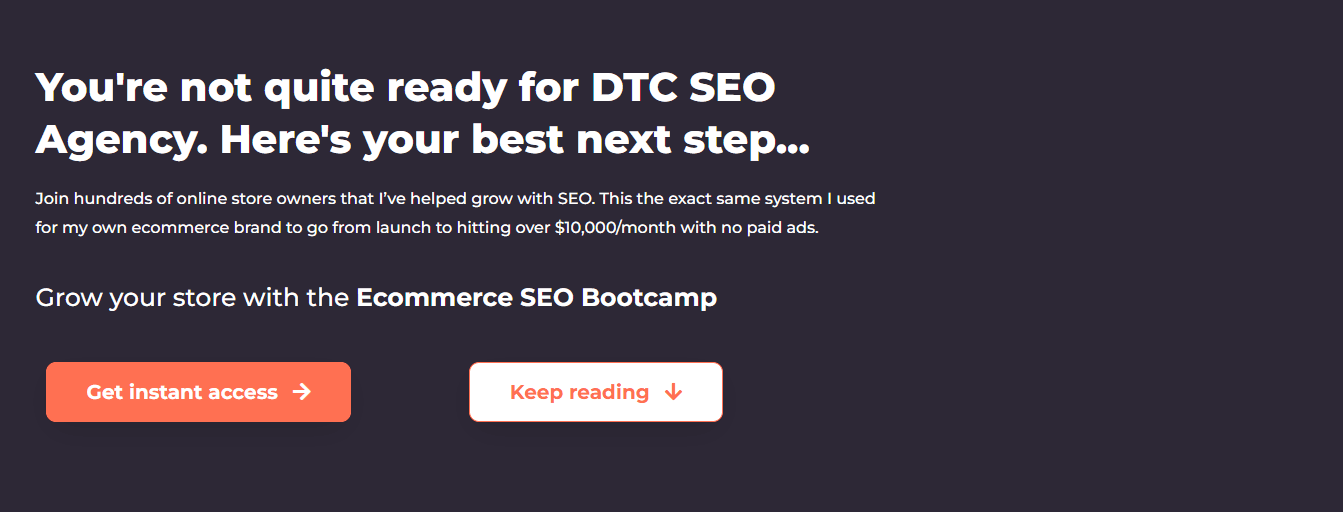
Freddie Chatt’s Ecommerce SEO Bootcamp takes a focused, implementation-oriented approach. The course contains 18 lessons and costs $150, with lifetime access and regular updates according to the official page. Its curriculum concentrates on the tasks that can help a store develop sustainable organic visibility: finding customer search demand, optimizing high-value pages, creating content that supports sales, and acquiring relevant links.
At a Glance
Last reviewed: October 16, 2026
CoursesMag Expert Score
Score Breakdown
Why this score?
Focuses on commercial keywords, product and collection pages, content, and authority.
Why this score?
Emphasizes actionable tasks for improving a real store.
Why this score?
The instructor has ecommerce SEO consulting experience and relevant client testimonials.
Why this score?
Short, organized lessons keep the learning commitment manageable.
Why this score?
Lifetime access and updates add value, though the course costs $150.
Why this score?
Relevant to store owners, consultants, and ecommerce SEO practitioners.
Why this score?
The provider states that the course is regularly updated, but individual lesson dates are not listed.
Pros
- Lifetime access and updates add value, though the course costs $150.
Cons
- Costs more than free learning resources
- Not a comprehensive advanced technical SEO course
- A completion certificate is not advertised
Community Score
Ratings from learners — on the source platform and from CoursesMag members.
Learner ratings on the source platform
No specific or citable ratings or reviews are available.
CoursesMag community rating
Visit Freddie Chatt's official page for course details, lifetime access, and the current offer.
View Official CourseWhat does it cover?
The curriculum is divided into four parts:
SEO fundamentals: Understanding search opportunities, customer queries, competitors, and essential tools.
Money pages: Identifying high-intent keywords and optimizing collection and product pages.
Content strategy: Creating content that attracts potential buyers rather than traffic without a clear commercial purpose.
Authority building: Acquiring links through products, images, expertise, and other relevant opportunities.
This makes the course particularly useful for ecommerce SEO for product and category pages, as well as content and authority building. It is more focused than a broad digital marketing program and gives store owners a manageable route into implementing an ecommerce SEO strategy.
Main strengths
Short, focused lessons.
A clear emphasis on practical actions.
Training in commercial keyword targeting and link acquisition.
Lifetime access and regular updates.
Limitations
Two hours of training cannot cover every advanced technical SEO issue in depth. Store owners with extensive catalogs, thousands of URL variants, or complicated indexing problems may need an additional technical course. The official page does not list a completion certificate.
Best for
Business owners and marketers who want to improve real store pages and develop a practical plan for organic growth.
4. SearchBlueprint E-commerce SEO Academy
Best Free Comprehensive Resource
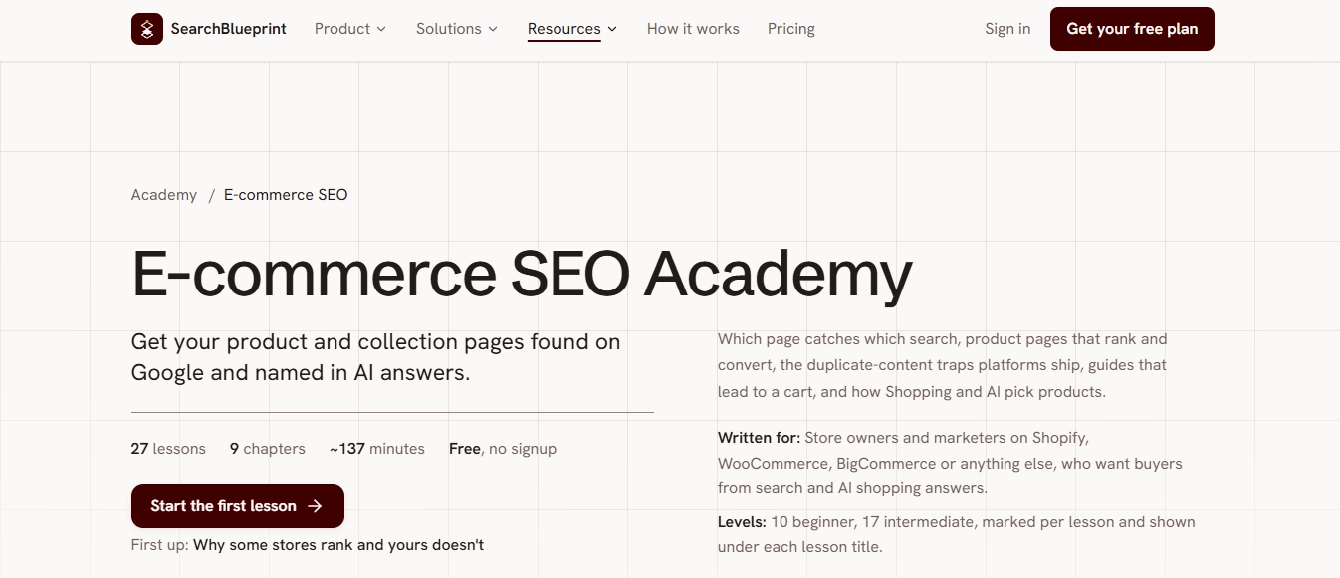
For readers who would rather start without paying, SearchBlueprint offers one of the broadest free ecommerce SEO learning tracks in this shortlist. The academy contains 27 lessons across nine chapters, with an estimated reading time of 137 minutes. No account or signup is required to access the lessons.
At a Glance
Last reviewed: October 16, 2026
CoursesMag Expert Score
Score Breakdown
Why this score?
Covers product and category SEO, technical issues, content, and measurement.
Why this score?
Lessons include actions learners can apply to their own stores.
Why this score?
Short, task-based written lessons make the concepts accessible.
Why this score?
No signup or payment is required, and each lesson is relatively short.
Why this score?
The complete ecommerce learning track is free.
Why this score?
Builds practical skills, but no completion certificate is listed.
Why this score?
The lessons display review dates, with a recent review in August 2026.
Pros
- Free access to all 27 lessons
- No account or signup required
- Covers product, category, and technical ecommerce SEO
- Includes practical actions and measurement guidance
Cons
- Free access to all 27 lessons
- No account or signup required
- Covers product, category, and technical ecommerce SEO
- Includes practical actions and measurement guidance
Community Score
Ratings from learners — on the source platform and from CoursesMag members.
Learner ratings on the source platform
No specific or citable ratings or reviews are available.
CoursesMag community rating
Start the free ecommerce SEO learning track without creating an account.
Start Free CourseWhat does it teach?
The curriculum addresses several issues that distinguish ecommerce from general website SEO:
Keyword targeting based on buying intent.
Product and category keyword research.
Collection structure and navigation.
Internal links that support important commercial pages.
Faceted navigation and filters.
Product titles, descriptions, images, and structured data.
Product variants, canonical tags, and duplicate URLs.
Buying guides, comparison content, and ecommerce measurement.
The course is written for store owners and marketers working with Shopify, WooCommerce, BigCommerce, or other platforms. It also distinguishes beginner and intermediate lessons, which makes it easier to choose an appropriate starting point.
Main strengths
Free access to all 27 lessons.
No signup requirement.
Coverage of both content and technical ecommerce SEO.
Examples relevant to different store platforms.
Limitations
The format is primarily written rather than video-based. Its curriculum is useful for learning and implementation, but readers should independently verify technical recommendations and use their own store data to evaluate results. The academy does not list a completion certificate.
Best for
Anyone looking for a free ecommerce SEO course with broad coverage before investing in paid training.
5. Rankar Academy E-Commerce SEO
Best for Technical SEO
Technical SEO becomes especially important when a store has a large catalog, frequent product changes, or complex filtering and navigation. Rankar Academy’s E-Commerce SEO course is designed around these challenges.
At a Glance
Last reviewed: October 16, 2026
CoursesMag Expert Score
Score Breakdown
Why this score?
Addresses product variants, faceted navigation, crawl management, and structured data.
Why this score?
Each module includes a practical assignment using the provider's tools.
Why this score?
The course is structured, but independent evidence about teaching quality is limited.
Why this score?
Intermediate technical topics require some existing SEO knowledge.
Why this score?
Lessons are free; only the certificate assessment costs extra.
Why this score?
Builds useful technical skills, with an optional verifiable certificate.
Why this score?
Focuses on current ecommerce technical SEO problems.
Pros
- Free access to all course lessons
- Detailed focus on faceted navigation and product variants
- Practical assignments in each module
- Optional verifiable certificate
Cons
- Intermediate technical concepts may challenge beginners
- Practical exercises use Rankar tools
- The certificate requires a separate paid assessment
Community Score
Ratings from learners — on the source platform and from CoursesMag members.
Learner ratings on the source platform
No specific or citable ratings or reviews are available.
CoursesMag community rating
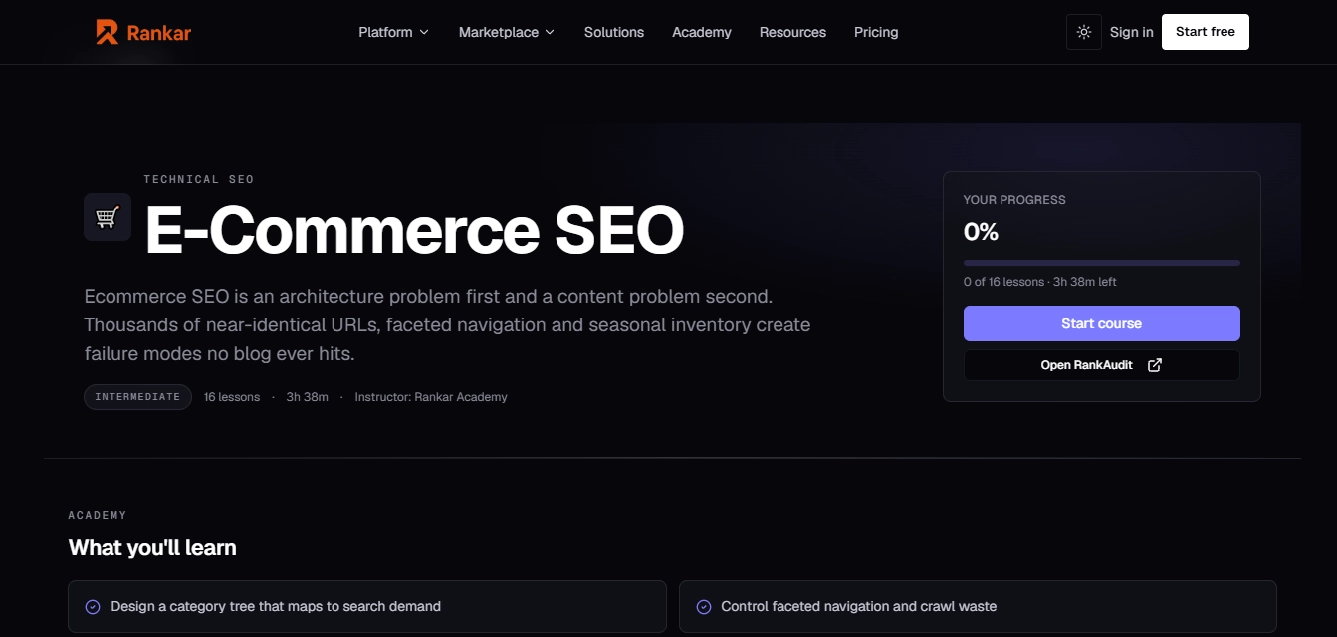
It contains 16 lessons across four modules. The provider makes the lessons freely accessible, while the final assessment and certificate cost approximately $11. The course focuses on category architecture, faceted navigation, crawl waste, product duplication, Product and Review structured data, and out-of-stock, seasonal, or discontinued items.
Read the free lessons and review the separate certificate requirements on Rankar Academy.
Start Free CourseWhy this matters for ecommerce
A large store can generate many URLs that differ only by a filter, product variant, or parameter. Without a sensible indexing strategy, search engines may spend time crawling low-value URLs instead of discovering and refreshing important pages.
A technical SEO course for ecommerce websites should therefore go beyond basic title tags and meta descriptions. It should explain how to make crawling, indexation, canonicalization, and product data work together.
For a broader look at technical training, see our guide to the best technical SEO courses in 2026.
Rankar is particularly relevant for learning faceted navigation SEO and handling ecommerce duplicate content. Its lessons also connect technical concepts with tasks in the provider’s own SEO tools.
Main strengths
Focus on technical problems specific to ecommerce.
Practical coverage of filtering, variants, and inventory changes.
Lessons accessible without purchasing a course.
Optional certification assessment.
Limitations
The course is aimed at intermediate learners, and its exercises make use of Rankar tools. Before relying on its certificate for professional development, consider the difference between a vendor-issued certificate and a widely recognized professional qualification.
Best for
SEO professionals and store managers responsible for large catalogs or technically complicated ecommerce websites.
6. PINSEO Ecommerce SEO Course for Sales
Best for Hands-On Implementation
PINSEO’s Ecommerce SEO Course for Sales stands out because it asks learners to work through a defined project instead of only watching lessons or reading about SEO principles.
At a Glance
Last reviewed: October 16, 2026
CoursesMag Expert Score
Score Breakdown
Why this score?
Focuses on product pages, category pages, keyword mapping, and measurement.
Why this score?
Includes a six-page project, workbook, and editable worksheets.
Why this score?
Written lessons, worked examples, and self-checks support implementation.
Why this score?
The project-based structure helps learners focus on a manageable set of pages.
Why this score?
Provides practical templates, although independent reviews are limited.
Why this score?
The project may support a practical portfolio, but no certificate is included.
Why this score?
Includes current Shopify and WooCommerce examples and a measurement plan.
Pros
- Includes a workbook and editable worksheets
- Covers Shopify and WooCommerce examples
- Includes a 30-day implementation plan
Cons
- Primarily written rather than video-based
- No course certificate is included
- Limited independent reputation evidence compared with established providers
Community Score
Ratings from learners — on the source platform and from CoursesMag members.
Learner ratings on the source platform
No specific or citable ratings or reviews are available.
CoursesMag community rating
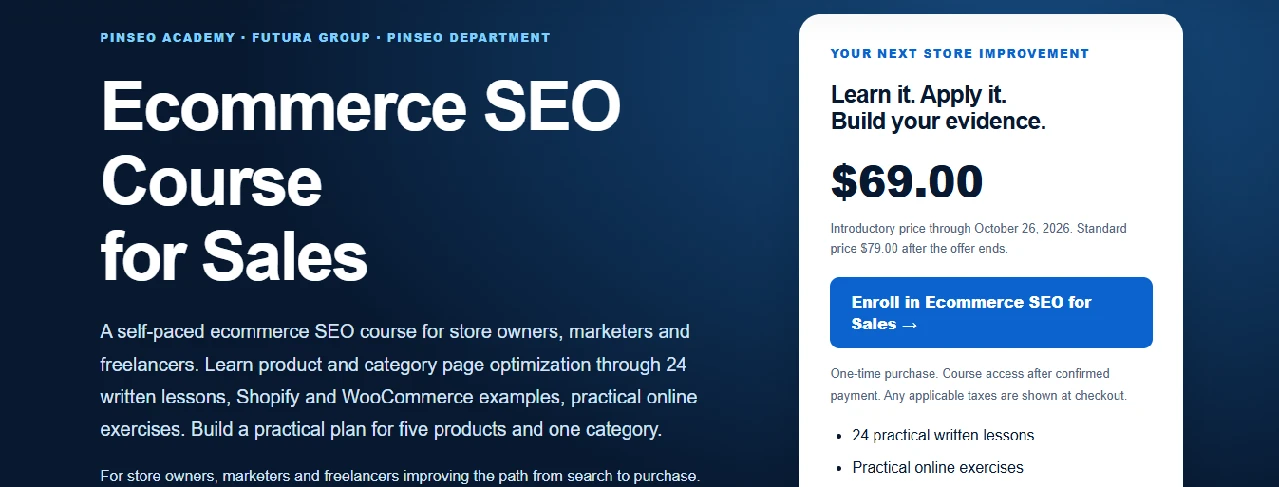
The course contains eight modules and 24 written lessons, with examples for Shopify and WooCommerce. It includes an 11-page implementation workbook, 10 editable CSV worksheets, worked examples, self-check answers, and a capstone project with a 30-day plan. The introductory price is $69 through October 26, 2026; the listed standard price afterward is $79.
Check the official page for the course curriculum, downloadable resources, and current price.
View Course & PricingWhat makes its approach different?
The main exercise is deliberately manageable: select five products and one category, decide why these pages matter, document the planned improvements, and establish how you will evaluate the changes.
This project-based format can be useful when you already know some SEO fundamentals but need a repeatable workflow for client projects or your own store. It brings together product keyword research, product and category page optimization, buying questions, implementation, and measurement.
Main strengths
A clearly defined practical project.
Editable templates and worksheets.
Shopify and WooCommerce examples.
A plan for applying learning to a real store.
Limitations
The course is text-based, rather than a video bootcamp. It also has less publicly established evidence of long-term reputation than more established providers. Treat the workbook and practical assignments as the main reason to choose it, and assess the course content before assuming it offers the same depth as a longer technical program.
Best for
Store owners, freelancers, and marketers who want an online ecommerce SEO course that leads to a concrete implementation plan.
7. How to Boost E-Commerce SEO with Internal Linking
Best Specialized Free Course
Not every useful course needs to cover the entire SEO discipline. Semrush SEO courses focuses on ecommerce internal linking, a specialized area that can have a substantial effect on how shoppers and search engines move through a store.
At a Glance
Last reviewed: October 16, 2026
CoursesMag Expert Score
Score Breakdown
Why this score?
Covers internal linking deeply but does not cover the entire ecommerce SEO workflow.
Why this score?
Includes practical methods for auditing and improving internal links.
Why this score?
Taught by Luke Carthy, an experienced ecommerce growth consultant.
Why this score?
Starts with fundamentals before covering advanced troubleshooting.
Why this score?
Free access and a completion certificate.
Why this score?
Develops a useful specialist skill for ecommerce SEO work.
Why this score?
Covers relevant technical issues, though a specific latest-update date was not verified.
Pros
- Free course with a certificate
- Specialized ecommerce internal linking curriculum
- Covers product pages, categories, navigation, and pagination
- Taught by an experienced ecommerce consultant
Cons
- Does not cover all ecommerce SEO topics
- Best suited to learners with some SEO knowledge
- No clear latest-update date was verified
Community Score
Ratings from learners — on the source platform and from CoursesMag members.
Learner ratings on the source platform
No specific or citable ratings or reviews are available.
CoursesMag community rating
The course contains five lessons covering introductory concepts, internal linking principles, best practices, advanced issues, and troubleshooting. Topics include links to product and category pages, navigation, canonical tags, JavaScript dependencies, redirects, pagination, orphaned pages, and anchor text. The course is free and offers a Semrush Academy certificate.
Enroll for free and earn a Semrush Academy certificate after completing the course.
Enroll for FreeWhy include a specialized course?
A store may have excellent product descriptions and a reasonable category structure, yet still struggle to distribute internal links effectively. Important commercial pages can become difficult to discover, while unrelated links or poor navigation can weaken the site’s information architecture.
Semrush gives learners a more focused way to investigate those issues. Its instructor, Luke Carthy, works across ecommerce growth, SEO, analytics, and conversion optimization.
Main strengths
Free access and a completion certificate.
A dedicated ecommerce internal linking curriculum.
Coverage of advanced troubleshooting issues.
Suitable for store owners and SEO professionals.
Limitations
This course is not a complete ecommerce SEO course. It concentrates on one important skill and works best alongside broader training in keyword research, product optimization, site structure, and technical SEO.
Best for
Learners who already understand SEO fundamentals and want to strengthen their internal linking skills.
What SEO Practitioners Say About Learning Ecommerce SEO
To add a practitioner perspective, I reviewed discussions from the SEO community on Reddit. These are individual experiences and recommendations, not controlled course evaluations, but they help identify what learners value beyond a course’s marketing claims.
1. Practical ecommerce link building is worth learning separately
In the discussion Some great free SEO courses worth the time in 2026, Freddie Chatt’s five-day Ecommerce Link Building Crash Course is singled out as a resource that addresses real ecommerce link-building techniques. It covers product-led links, digital PR, image-based link opportunities, newsjacking, and converting unlinked brand mentions into backlinks. The same recommendation appears in the discussion Free SEO courses worth the time rn.
This is a useful reminder that a general SEO curriculum may introduce backlinks without explaining how a retailer can earn links to specific products or categories. If link acquisition is your main weakness, Freddie’s free email series is a practical complement to a comprehensive course.
2. A specialized ecommerce course can be valuable, but prior knowledge matters
In What’s the best SEO course?, one Reddit user reported finding Luke Carthy’s ecommerce SEO course very useful, while explicitly noting that it would probably have been of little use without some prior SEO knowledge.
The broader lesson is that course suitability depends on your experience level. A beginner may get more value from a structured program such as Yoast or Reliablesoft, while an experienced SEO professional can benefit from a specialist course on architecture, crawling, or internal links. For readers who are still building their SEO fundamentals, our guide to the best SEO courses for beginners in 2026 provides additional options. Luke Carthy’s historical course is not included in the seven main recommendations because I could not verify a current enrollment page.
3. Testing on a real website matters more than collecting courses
The discussion What’s the best course/guide to SEO in 2025? contains a recurring piece of advice: experiment on your own site, follow reliable documentation, and test recommendations rather than depending entirely on paid courses. The self-taught SEO discussion also includes suggestions to learn fundamentals first, use tools such as Search Console and analytics, and build practical experience.
I would apply the same principle to ecommerce SEO courses: choose a small group of products and categories, implement the lessons, and monitor changes in impressions, clicks, indexing, and conversions. You will learn more from connecting the course to an actual store than from finishing multiple courses without applying the material.
The other Reddit links supplied for this article provide useful general SEO learning discussion and community context, but they do not establish an objective ranking of the seven ecommerce courses. The r/eCommerceSEO community is better treated as an ongoing place to research practical ecommerce problems than as evidence that one course is definitively the best.
Free vs. Paid Ecommerce SEO Courses: Which Should You Choose?
Free and paid training serve different purposes. The best choice depends on whether you need to understand fundamentals, solve a specific problem, or follow a structured curriculum from start to finish.
Best free ecommerce SEO courses
If you want to avoid paying at the beginning, start with these options:
SearchBlueprint: Broad coverage of ecommerce strategy, content, products, technical issues, and measurement.
Rankar Academy: More focused on intermediate technical SEO, including facets, crawl waste, structured data, and inventory changes.
Semrush Academy: Best for a specific skill, ecommerce internal linking.
- Freddie Chatt’s Ecommerce Link Building Crash Course: A free five-day email series for ecommerce link-building skills.
These are the strongest starting options if your priority is a free ecommerce SEO course. They do not all offer the same kind of learning, and the free courses should not be assumed to provide certificates.
SEO courses free
When paid ecommerce SEO courses make sense
Paid ecommerce SEO courses can be worthwhile when they provide something beyond information that is already freely available. Look for well-organized lessons, strong examples, implementation exercises, feedback, and a curriculum you can apply to your store.
Yoast is suitable for structured, broad learning; Reliablesoft for a beginner-friendly curriculum; Freddie Chatt for practical ecommerce growth; and PINSEO for a project-based workflow.
Before enrolling in paid ecommerce SEO courses, check whether you are purchasing a standalone course or an annual software plan, whether access expires, whether lessons are updated, and whether a certificate is included.
How to Choose an Ecommerce SEO Course for Your Platform
Not every online store has the same needs. When choosing a course, consider your platform as well as your experience level.
Shopify SEO course: What should you look for?
A good Shopify SEO course should address more than basic title tags. Shopify’s own documentation explains important considerations in site structure, collection and product hierarchy, descriptive URLs, navigation, and internal linking.
For ecommerce SEO course for Shopify store owners, look for teaching on collection pages, product variants, duplicate URLs, product structured data, themes and speed, and how to measure performance. Yoast’s course covers Shopify along with other store types, while SearchBlueprint also includes Shopify platform SEO in its free curriculum.
Shopify ecommerce SEO training for beginners can start with official documentation, followed by a comprehensive course when you need help with deeper technical or strategic issues. The official guides are learning resources rather than a full certificate course, so don’t mistake them for a formal Shopify SEO course.
WooCommerce SEO course: What matters most?
A WooCommerce SEO course should cover product and category optimization, site structure, structured data, internal linking, and the effects of WordPress plugins on the technical setup.
Yoast is particularly relevant here because its ecommerce course is available through eligible Yoast plans, including WooCommerce SEO. Reliablesoft also covers ecommerce keyword research, product pages, category pages, and site structure.
If you are specifically looking for an ecommerce SEO course for WooCommerce, evaluate whether the lessons address the configuration of your own store, rather than assuming every ecommerce training program gives equal attention to every platform.
What Should an Ecommerce SEO Course Teach?
The following subjects are the most useful benchmarks for comparing a course. Together, they help distinguish specialist SEO courses for ecommerce from programs that teach only general SEO concepts.
| Skill area | What good training should cover | Why it matters |
|---|---|---|
| Ecommerce keyword research | Product keyword research, commercial intent, collection demand, and search intent mapping | Helps align the right page with the right query |
| Product page SEO | Titles, descriptions, images, variants, reviews, and structured data | Helps products appear for relevant searches and answer buyer questions |
| Category page SEO | Collection structure, category descriptions, filters, navigation, and internal links | Helps users and search engines discover important groups of products |
| Ecommerce technical SEO | Crawling, indexing, URL parameters, canonical tags, faceted navigation, and duplicate content | Reduces technical problems across large catalogs |
| Ecommerce site structure | Hierarchy, breadcrumbs, navigation, and links between guides, collections, and products | Supports discovery and distributes internal link signals |
| Ecommerce internal linking | Navigation links, related products, anchor text, pagination, and orphaned pages | Helps connect important pages and make the store easier to crawl |
| Ecommerce link building | Digital PR, product-led links, partnerships, and relevant backlink acquisition | Builds authority and can send qualified referral traffic |
| Ecommerce SEO strategy | Keyword targeting, content planning, technical priorities, and measurement | Connects SEO activities to business objectives |
| Product schema SEO | Product structured data, price, availability, and eligible review information | Helps search engines interpret product information |
| Ecommerce site speed optimization | Image optimization, mobile performance, scripts, themes, and Core Web Vitals | Supports a better user experience |
| Ecommerce SEO audit | Finding indexation problems, weak category pages, duplicate URLs, and internal link issues | Provides an actionable improvement plan |
| Ecommerce content strategy | Buying guides, comparison pages, FAQs, and links to relevant products | Connects informational searches to commercial pages |
These subjects are especially important for technical SEO for ecommerce websites, because problems can affect many URLs simultaneously rather than only one article or landing page.
A course does not need to cover every item in equal depth. A short ecommerce SEO link building course may specialize in backlink acquisition, while an advanced ecommerce SEO course should generally address more complex issues such as faceted navigation SEO, ecommerce duplicate content, structured data, and crawl management.
When comparing curricula, check whether the provider actually teaches each topic. Do not assume that a course covers product schema SEO, ecommerce structured data, or advanced crawling simply because its description uses the phrase “technical SEO.”
How to Measure Whether Your Training Is Working
An ecommerce search engine optimization course should give you a process you can apply, not just a collection of tactics. Before you start, record the state of your store. After implementing the lessons, review your pages and track performance using Google Search Console and analytics.
For example, you can choose a few important product pages and categories, improve the targeting and internal links, and monitor impressions, clicks, average positions, organic sessions, and conversions. Results will depend on your starting point, competition, implementation, and how search engines respond, so no training program can guarantee rankings or sales.
Useful ecommerce SEO tools can help you investigate queries, find crawl and indexation issues, review backlinks, and monitor changes. However, the objective is not to use the greatest number of tools; it is to use the right ones to make and evaluate better decisions.
This practical approach helps improve organic traffic for ecommerce websites while giving you evidence about which parts of your ecommerce SEO strategy are working. It also helps you prioritize ecommerce search visibility based on business outcomes rather than rankings alone.
Frequently Asked Questions
What is the best ecommerce SEO course?
For comprehensive learning, I would start with Yoast or Reliablesoft. Freddie Chatt is a strong option for practical store optimization and growth, while Rankar and Semrush are more suitable for specific technical or internal linking needs. The best ecommerce SEO course depends on your experience level and the problems you need to solve.
Is a free ecommerce SEO course enough to get started?
Yes. SearchBlueprint offers a broad free curriculum, Rankar provides free technical lessons, and Semrush offers a free course with a certificate. You can learn the fundamentals without paying, but the value comes from applying the lessons to a real store and evaluating results.
Do I need an ecommerce SEO certification?
An ecommerce SEO certification can document completion of a course, but employers and clients may care just as much about practical ability. Choose a course with relevant exercises, understand exactly what the certificate represents, and build evidence of your work through audits and measured improvements.
How long does ecommerce SEO training take?
It depends on the format. Some specialized courses take around an hour or two, while broader curricula need more time. SearchBlueprint estimates around 137 minutes of reading, the Semrush internal linking course takes about 158 minutes, and the Freddie Chatt bootcamp has 18 lessons across approximately two hours. The time needed to implement and evaluate the lessons will be longer.
Can I learn ecommerce SEO without buying a course?
Yes. Official platform documentation, free SEO courses, and hands-on testing can provide a sound foundation. A course is most useful when its structure, examples, and exercises save you time or help you solve problems you cannot confidently handle alone.
Is general SEO training enough for an online store?
General training provides important fundamentals, but it may not address product variations, category architecture, faceted navigation, out-of-stock products, and store-specific internal linking. For that reason, SEO for online retailers benefits from specialist training that reflects how ecommerce websites are built and maintained.
Final Verdict
The best ecommerce SEO courses are not necessarily the longest, most expensive, or most frequently mentioned. The most useful option is the one whose curriculum matches your current skill level and the needs of your store.
For a comprehensive foundation, start with Yoast or Reliablesoft. Choose Freddie Chatt when you need a practical framework for ecommerce growth, SearchBlueprint for broad free learning, Rankar for technical SEO, and PINSEO for an applied project. Use Semrush Academy to strengthen internal linking rather than treating it as a complete SEO curriculum.
Ultimately, the best ecommerce SEO courses in 2026 should help you do more than understand SEO concepts. They should enable you to research product demand, optimize product and category pages, solve technical problems, improve internal links, and measure whether those changes are helping your business.
The strongest ecommerce SEO training combines structured learning with practical implementation. Choose a course you can apply to your own store, document what changes, and use the results to guide your next decisions.