
AI has changed SEO, but not in the simplistic way many course pages make it sound.
SEO is not suddenly dead, and adding ChatGPT prompts to a traditional SEO curriculum does not turn a course into an AI SEO program.
What has changed is the search environment itself. Google now surfaces AI-generated answers through features such as AI Overviews and AI Mode, while ChatGPT, Perplexity, Gemini, and other LLM-powered systems increasingly act as discovery layers between users and websites.
That creates a new training problem.
You still need to understand traditional SEO, technical SEO, content, links, entities, and search intent. But you also need to understand how AI systems retrieve information, interpret entities, synthesize answers, choose sources, and decide which brands and pages are worth mentioning or citing.
That is what I looked for when evaluating the best AI SEO courses in 2026.
I did not simply copy the courses that appear repeatedly in other SEO roundups. I looked at their current curriculum, practical depth, credibility, and freshness—because in a field changing as quickly as AI search, a course that was relevant last year is not automatically relevant today.
That is also why SEOSLY’s AI SEO Expert did not make this list. The course is still presented on its official landing page as a Black Friday 2025 / AI SEO Course 2025 program, and I could not find sufficient evidence of meaningful updates since then.
For GEO and AEO training in particular, freshness matters. AI search is evolving too quickly for me to recommend a course simply because it appears repeatedly in other “best AI SEO courses” articles.
A course does not earn a place on this list because other websites recommend it. It earns a place because I believe it is worth taking today.
Quick Decision Guide
| Your Goal | Our Top Pick | Provider | Platform | Why |
|---|---|---|---|---|
| 🏆 Best overall | Optimize Pages for AI Search with GEO/AEO, CXL | CXL | CXL Institute | Focused, practitioner-led training on AI search behavior, citable content, LLM visibility, and comparison-driven search |
| Best technical AI search course | From SEO to AEO: Optimising for AI-led Search, Jellyfish | Jellyfish | Jellyfish Training | Exceptional depth across RAG, query fan-out, embeddings, AI accessibility, structured data, and measurement |
| Best comprehensive AI SEO course | AI Search & SEO Mastery, Search Atlas | Search Atlas | SCHOLAR | Broadest combination of traditional SEO, semantic SEO, technical SEO, authority, automation, and GEO |
| Best live AEO course | AEO Masterclass: AI Search Beyond SEO, Maven | Maven | Maven | Best live AEO course |
| Best free AI SEO course | AI Search Optimization Masterclass, Surfer | Surfer | Surfer Academy | Free, practical training covering AI visibility, content, authority, digital PR, measurement, and workflows |
| Best quick AEO foundation | Answer Engine Optimization Course, Ahrefs | Ahrefs | Ahrefs Academy | Short, focused introduction covering AI search, citations, mentions, execution, technical AEO, and measurement |
| Best for AI visibility measurement | AI Visibility Essentials with Semrush | Semrush | Semrush Academy | Strongest emphasis on prompts, AI visibility, brand mentions, share of voice, and reporting |
| Best structured GEO course | AI SEO: Mastering Generative Engine Optimization (GEO), Coursera | SkillUp | Coursera | Structured GEO introduction with labs, quizzes, content restructuring, schema, and GEO measurement |
What makes a good AI SEO course in 2026?
Before ranking the courses, there is an important distinction to make.
When people search for an AI SEO training 2026 program, they can mean two very different things.
The first is AI-assisted SEO.
That means using ChatGPT, Claude, Gemini, or other AI tools to make existing SEO workflows faster, such as keyword research, content briefs, competitor analysis, technical audits, reporting, and automation.
The second is AI search optimization.
This is about making your brand and content more likely to be discovered, understood, mentioned, recommended, or cited inside AI-generated answers.
That includes:
- AEO — Answer Engine Optimization
- GEO — Generative Engine Optimization
- LLM SEO
- AI search visibility
- AI citations
- entity SEO
- structured data
- AI crawlers
- citable content
- brand mentions
- AI visibility measurement
The distinction matters because a course can be excellent at SEO with AI while teaching very little about how AI search actually works.
For this list, I gave much more weight to courses that understand the second problem.
At the same time, I do not believe an AI SEO course should tell you to forget traditional SEO. The foundation is still SEO; AI search adds a new layer on top of it.
That is the standard I used.
1. CXL – Optimize Pages for AI Search with GEO/AEO
Best AI SEO course for experienced SEOs
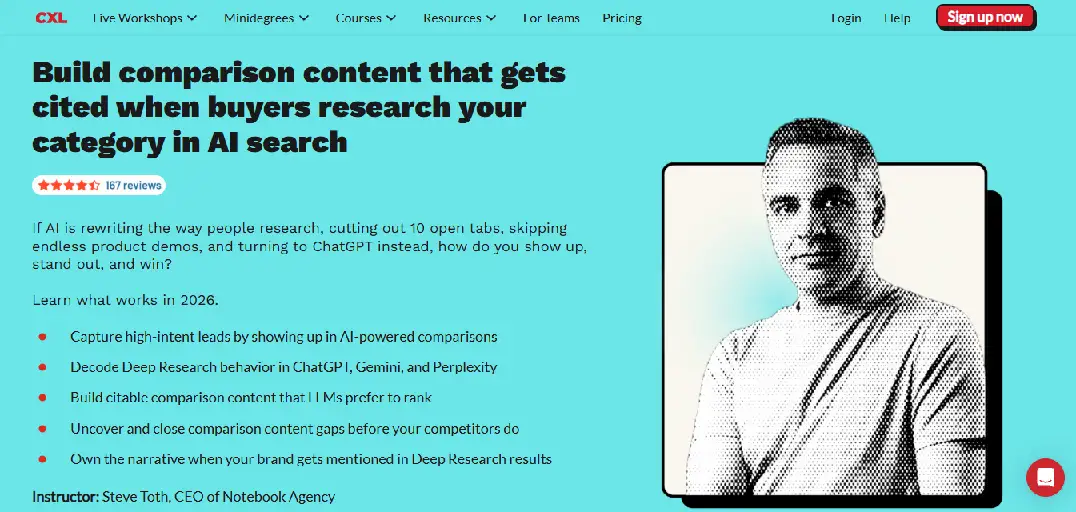
CXL’s Optimize Pages for AI Search with GEO/AEO is my top specialist pick for someone who already understands traditional search and wants to get much deeper into AI-powered discovery.
The most important thing about this course is what it does not try to be.
It is not a giant “AI SEO for everyone” curriculum that spends five minutes each on prompts, content, ChatGPT, schema, GEO, and automation.
Instead, Steve Toth focuses heavily on a specific and commercially important problem: how buyers use AI systems to compare products and brands, and how your content can become part of that research process.
Want to understand how AI-powered research is changing commercial search? CXL’s AI search training takes a much deeper look at citations, comparison content, and LLM visibility.
CXL’s AI search trainingThe current course focuses on AI-powered comparisons, Deep Research behavior in ChatGPT, Gemini, and Perplexity, citable comparison content, comparison-content gaps, and controlling the information available about your brand. CXL positions it as an intermediate-to-advanced program and currently lists the on-demand version at $299, with roughly two hours of material.
This is exactly why I rate it highly.
The interesting part of modern AI search is not simply getting your webpage to rank for a keyword. The bigger question is:
What happens when an AI system researches the category on behalf of the user?
A traditional SEO workflow might optimize a comparison page for “best project management software.”
An AI-search workflow has to think about what happens when ChatGPT or Gemini effectively performs that comparison itself, combines information from multiple sources, and generates a recommendation.
That changes the content strategy.
You need to think about:
citable content → comparison intent → information gaps → entity understanding → third-party validation → AI retrieval → final recommendation
That’s much more useful than another generic “50 ChatGPT prompts for SEO” course.
At a Glance
Last reviewed: October 6, 2026
CoursesMag Expert Score
Score Breakdown
Why this score?
For a focused course, CXL covers the most commercially relevant parts of AI search unusually well. It goes into Deep Research behavior, LLM visibility, brand mentions, citations, citable comparison content, and content gaps rather than treating GEO as a collection of generic AI-writing tactics.
Why this score?
This is one of its biggest strengths. Learners are asked to analyze their own branded or product queries across ChatGPT, Gemini, and Perplexity, log citations and narrative patterns, and identify competitors appearing more frequently. That is much closer to real AI-search work than passive video consumption.
Why this score?
Steve Toth's background is directly tied to SEO and organic growth, and the course is structured around concrete search problems rather than broad AI theory.
Why this score?
The course is relatively focused, but it assumes you already understand SEO and content strategy. It is not designed as a zero-to-one introduction.
Why this score?
The current on-demand version is $299. That is reasonable for specialized practitioner training, but obviously cannot compete on raw value with the free courses from Surfer or Ahrefs.
Why this score?
The skills are closely aligned with where advanced SEO work is heading: AI visibility, citation analysis, commercial comparisons, and LLM-driven discovery.
Why this score?
The current CXL page explicitly positions the course around what works in 2026, with current examples involving ChatGPT, Gemini, and Perplexity.
Pros
- Excellent focus on AI-powered buyer research
- Strong practical citation and visibility exercises
- Taught by an experienced SEO practitioner
- Useful for experienced SEOs rather than generic AI beginners
- Current 2026 positioning
Cons
- Not suitable as a first SEO course
- Narrower than a full AI SEO curriculum
- Focuses heavily on comparison and commercial content
- Paid when several alternatives are free
Community Score
Ratings from learners — on the source platform and from CoursesMag members.
Learner ratings on the source platform
CoursesMag community rating
What I like
CXL has a strong operator-focused education model, and the instructor’s background is directly relevant to SEO rather than being primarily an AI educator who added SEO later. CXL describes Steve Toth as CEO of Notebook Agency and highlights his past organic-search results at BrainStation.
What I don’t like
This is not the best AI SEO course for beginners.
It assumes you already understand search, content, and SEO strategy. I also would not buy it simply because you want to “learn AI.” Its strength is very specific: AI search optimization with an emphasis on commercial comparison content and citation.
My verdict
Highly Recommended
Best suited to experienced SEOs, content strategists, and growth marketers who already understand SEO fundamentals and want a serious introduction to GEO/AEO thinking.
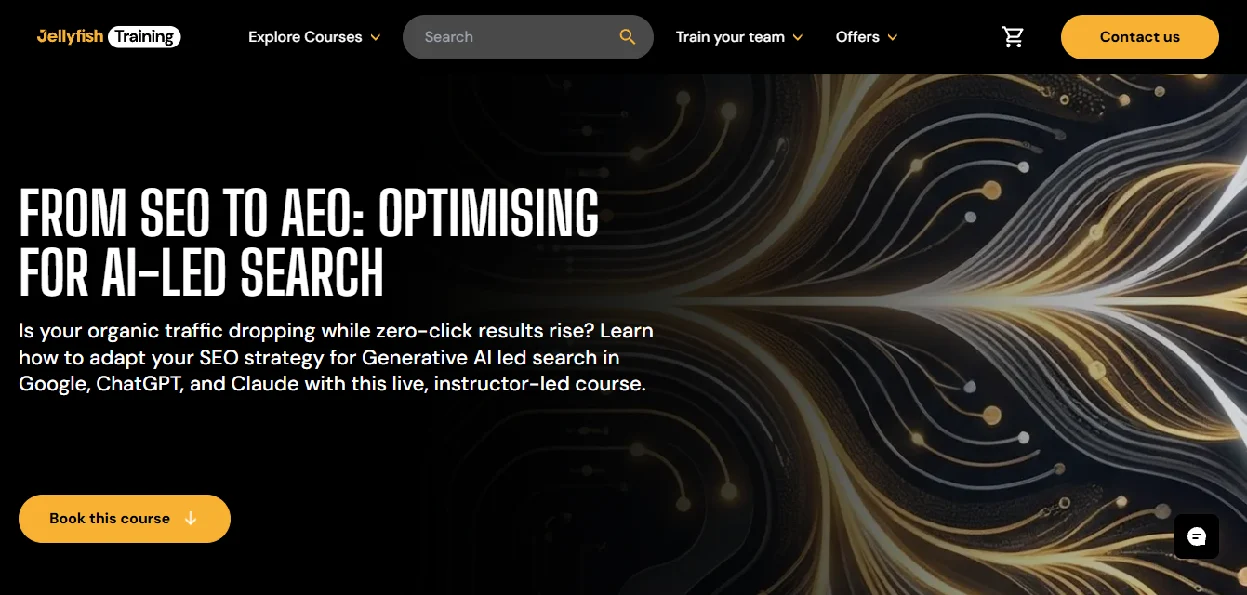
2. Jellyfish – From SEO to AEO: Optimising for AI-led Search
Best technical AI search optimization course
Jellyfish is one of the courses I would recommend to an experienced SEO who wants to understand what is happening underneath the surface rather than just learn content formatting tricks.
The course is explicitly positioned for intermediate to advanced SEO professionals. It covers AEO and GEO, but the syllabus goes much deeper into how AI-led retrieval works. Topics include Retrieval Augmented Generation (RAG), query fan-out, vector embeddings, cosine similarity, AI accessibility, JavaScript, markdown, structured data, measurement, information gain, and external sources of citations.
That is a very different proposition from most beginner-oriented AI SEO courses.
For example, the course does not stop at “write shorter answers so AI can understand them.” It asks more technical questions:
How does generative retrieval differ from classic retrieval?
How does query fan-out affect what content gets selected?
What happens when an AI system needs to combine multiple sources?
What technical barriers can prevent information from being retrieved?
Which external sources influence AI-led search?
And how do you measure whether your work is actually changing AI visibility?
This is the kind of curriculum I want to see in an advanced AI SEO course.
Need a deeper technical understanding of how AI systems retrieve and process content? Jellyfish’s technical AEO training goes well beyond basic GEO tactics.
Jellyfish’s technical AEO trainingThe current scheduled course is a one-day live program, offered online or in person, priced at $549 plus VAT. Jellyfish also displays a 5/5 average Feefo rating based on four verified reviews, including reviews from 2026 praising the presentation, practical relevance, and instructor knowledge.
That review sample is small, so I would not treat 5/5 as statistical proof that the course is exceptional. But it is useful supporting evidence.
At a Glance
Last reviewed: October 6, 2026
CoursesMag Expert Score
Score Breakdown
Why this score?
This is probably the technically strongest curriculum in the list. It covers RAG, query fan-out, vector embeddings, cosine similarity, AI accessibility, JavaScript, Markdown, structured data, information gain, and external citation sources alongside AEO and GEO.
Why this score?
The course is built around how an SEO can actually adapt content and technical infrastructure for AI-led retrieval and measure the result.
Why this score?
It is a live, instructor-led course rather than a large passive video library, and the current Feefo reviews are strongly positive.
Why this score?
This is deliberately technical. Concepts such as vector embeddings, cosine similarity and generative retrieval are not beginner material.
Why this score?
The scheduled course is currently $549 + VAT for a one-day session. The price can be justified for professionals or teams, but it is a significant investment for individual learners.
Why this score?
For an SEO manager or technically minded practitioner, the material maps closely to the emerging skill set around AI-led search.
Why this score?
The current course explicitly references Google AI Mode, AI Overviews, ChatGPT and Perplexity, and Jellyfish says the agenda may change as best practices evolve. Current 2026 sessions are already scheduled.
Pros
- Exceptional technical depth
- Covers RAG and query fan-out
- Strong technical AEO component
- Live instructor-led format
- Current 2026 sessions
Cons
- Expensive
- Too advanced for beginners
- One-day format limits how deeply every topic can be practiced
Community Score
Ratings from learners — on the source platform and from CoursesMag members.
Learner ratings on the source platform
CoursesMag community rating
What I like
The technical depth.
Especially:
RAG + query fan-out + vector embeddings + technical accessibility + structured data + measurement + citation sources
That combination is much closer to how I would expect a serious AEO training program to look.
What I don’t like
The course is not aimed at complete beginners.
And because this is a fast-moving field, Jellyfish explicitly says the agenda can change as best practices evolve. That is actually a positive sign in this category, but it also means you should expect some parts of any AI search course to age quickly.
My verdict
Highly Recommended
One of my strongest picks for SEO managers, advanced practitioners, agencies, and technically minded SEOs.
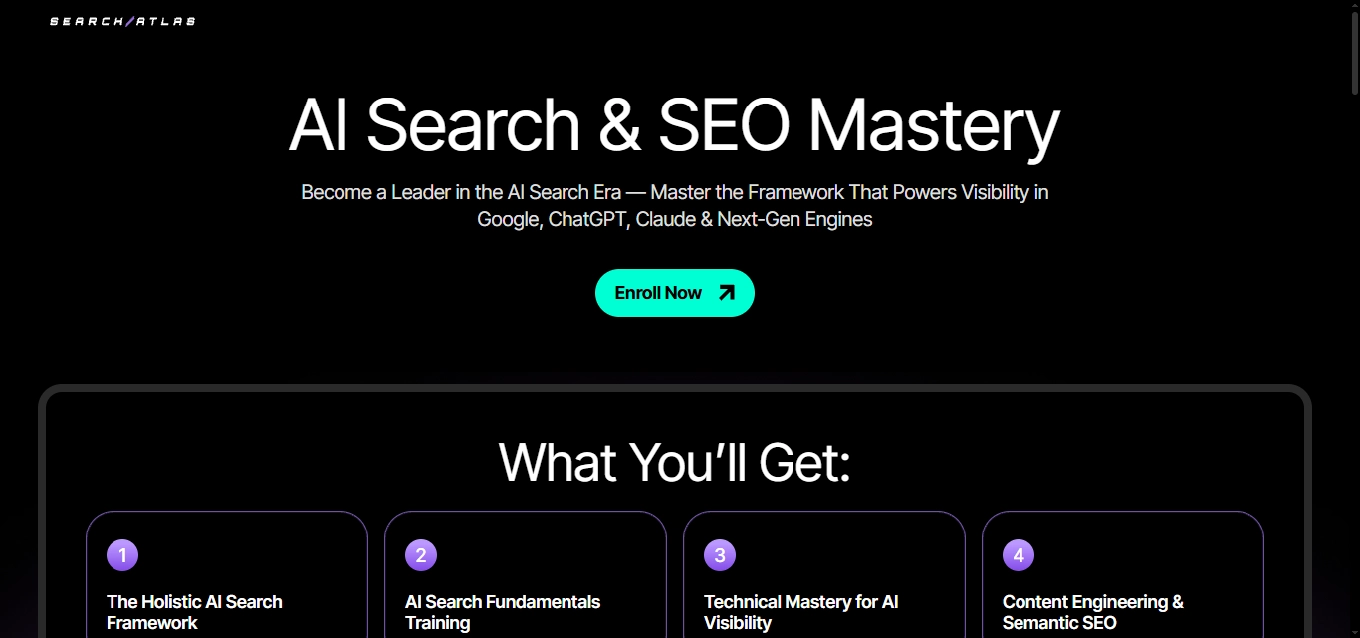
3. Search Atlas — AI Search & SEO Mastery
Best comprehensive AI SEO course
Search Atlas’s AI Search & SEO Mastery is a broader AI-search training program that combines traditional SEO with newer AI search optimization concepts.
What makes it relevant to this list is that it does not treat AI SEO as simply a collection of ChatGPT prompts or content-generation workflows. The program is positioned around the changing search landscape, including AI search visibility, generative search, traditional SEO, and the practical workflows needed to adapt to AI-driven discovery.
For me, that distinction matters.
Looking for a broader framework that connects technical SEO, semantic SEO, authority, automation, and GEO? Search Atlas’s broader AI SEO program is the most comprehensive option in this list.
Explore Search Atlas MasteryAn AI SEO course should not simply teach you how to use AI to do SEO faster. It should also help you understand how search itself is changing and how those changes affect visibility, content, entities, citations, and organic discovery.
At a Glance
Last reviewed: October 6, 2026
CoursesMag Expert Score
Score Breakdown
Why this score?
The breadth is the standout feature. The program connects traditional SEO with AI search fundamentals, technical visibility, semantic SEO, authority and links, UX, automation, and GEO.
Why this score?
The curriculum includes practical SEO workflows, audits, authority work, automation, and AI-search optimization rather than focusing exclusively on concepts.
Why this score?
The course is built around the Search Atlas framework and taught within the company's own ecosystem. That gives it a clear methodology, although there is less independent evidence of teaching quality than with established course providers such as CXL.
Why this score?
The scope is broad, which is useful but also means learners have to absorb a large number of SEO and AI-search concepts.
Why this score?
The current price is $997. The breadth is substantial, but that is still a major investment compared with free alternatives.
Why this score?
For someone transitioning from traditional SEO into AI search, the combination of technical SEO, semantic SEO, authority and GEO makes this one of the broader professional programs available.
Why this score?
The current course is explicitly positioned around Google, ChatGPT, Claude and next-generation search, and Search Atlas's documentation for the course was updated on September 30, 2026.
Pros
- Broad AI SEO curriculum
- Strong combination of traditional SEO and GEO
- Covers technical, semantic and authority layers
- Current 2026 material
- Useful for professionals transitioning into AI search
Cons
- High price
- Strong connection to Search Atlas tools
- Broad scope can feel overwhelming
- Less independent learner-review evidence
Community Score
Ratings from learners — on the source platform and from CoursesMag members.
Learner ratings on the source platform
No specific or citable ratings or reviews are available.
CoursesMag community rating
What I like
The biggest advantage is the breadth.
Compared with highly specialized courses such as CXL’s GEO/AEO program or Jellyfish’s technically focused AEO training, Search Atlas is positioned more broadly. That makes it a better fit for SEOs who want to understand AI search and SEO as an integrated discipline rather than study one narrow aspect of the subject.
It is also a more natural fit for someone who wants to move from traditional SEO into AI search without completely abandoning the fundamentals that still underpin organic search.
What I don’t like
The broader scope is also its limitation.
If you already have substantial SEO experience and specifically want to understand technical concepts such as retrieval architecture, query fan-out, vector embeddings, or AI accessibility, Jellyfish is the stronger specialist option.
Likewise, if your primary interest is commercial comparison content and AI-generated product recommendations, CXL is more focused.
So I would not describe Search Atlas as the deepest AI search course on this list. Its strength is the breadth of the AI SEO framework.
My verdict
Recommended
A good choice for SEOs and digital marketers who want a broader AI search and SEO program rather than a narrowly focused GEO/AEO course.
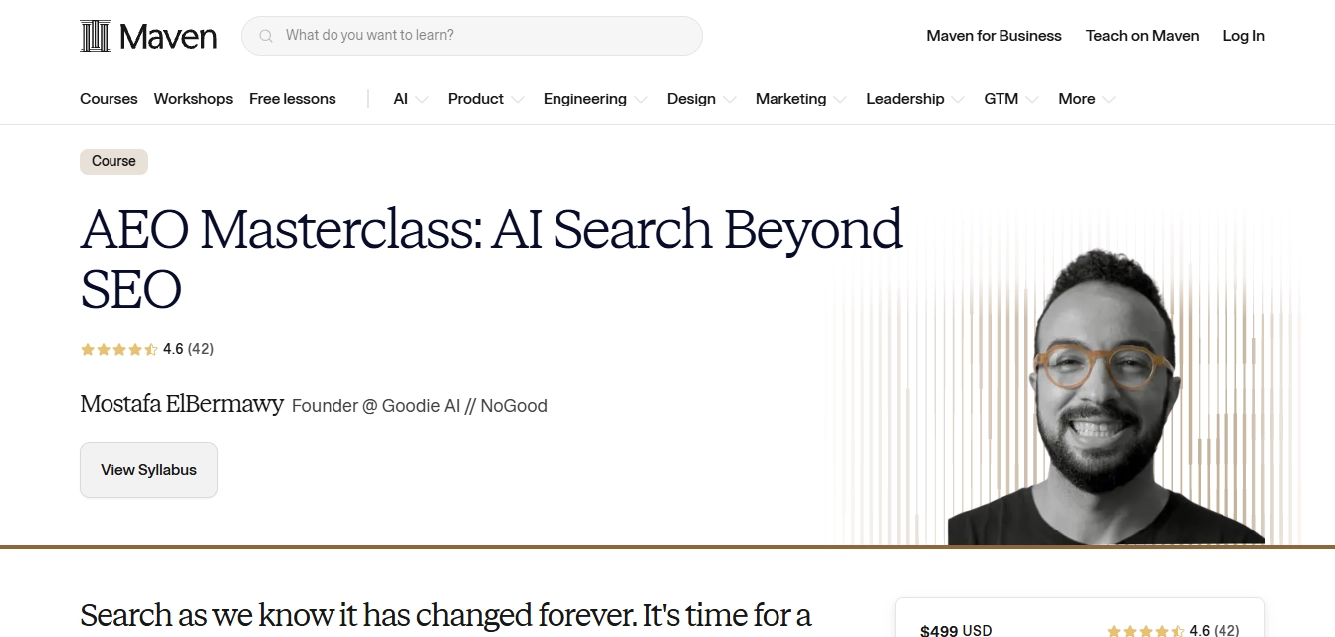
4. Maven – AEO Masterclass: AI Search Beyond SEO
Best live AEO course
Maven’s AEO Masterclass: AI Search Beyond SEO is considerably shorter than SEOSLY or Jellyfish, but its format is completely different.
It is a focused live cohort taught by Mostafa ElBermawy, founder of Goodie AI and NoGood. The current cohort is two live sessions covering:
AEO strategy → owned, earned and social content → technical AEO → AEO measurement
The course is currently priced at $499 and Maven lists a 4.6/5 rating from 42 ratings.
That rating matters more to me than a page full of hand-picked testimonials because it at least gives us a visible aggregate learner signal. It still does not prove instructional quality on its own, but it is useful evidence. What makes this course particularly relevant is that it treats AEO as a broader visibility problem.
Prefer learning AEO through live instruction rather than a large self-paced library? Maven’s live AEO masterclass is built around strategy, discussion, and practical AI-search workflows.
View Maven MasterclassThe curriculum looks beyond your own website and considers how owned, earned, and social content contribute to AI search visibility.
That matters because AI search visibility is not purely an on-page SEO problem.
An LLM can learn about your brand from your site, but also from third-party publications, communities, reviews, social platforms, and other sources. The strongest AEO strategies therefore often involve brand mentions and external validation, not just changes to your own pages.
The course also discusses AI Overview, AI Mode, ChatGPT, Gemini, Claude, and other LLM environments.
At a Glance
Last reviewed: October 6, 2026
CoursesMag Expert Score
Score Breakdown
Why this score?
It focuses on four important areas: AEO strategy, owned/earned/social content, technical AEO, and measurement. It is intentionally narrower than a full SEO curriculum.
Why this score?
The live format and real-brand AEO examples make it more application-oriented than a short recorded course.
Why this score?
The course is taught live by Mostafa ElBermawy, founder of Goodie AI and NoGood, and includes interactive sessions and community access.
Why this score?
The two-session format keeps it focused, although learners with no marketing or SEO background may still need additional training.
Why this score?
The current cohort costs $499 for two live sessions.
Why this score?
The focus on AEO strategy, brand visibility and measurement is relevant to experienced marketers and SEOs moving into AI search.
Why this score?
A current cohort is scheduled for October 28–29, 2026, making this one of the clearest examples of actively maintained live AI-search training.
Pros
- Live and interactive
- Strong focus on AEO strategy
- Covers owned, earned and social visibility
- Current 2026 cohort
- Certificate and lifetime access
Cons
- Expensive for only two sessions
- Not a full SEO curriculum
- Limited technical depth compared with Jellyfish
Community Score
Ratings from learners — on the source platform and from CoursesMag members.
Learner ratings on the source platform
CoursesMag community rating
What I like
The focused live format.
A good live course can be more useful than a 20-hour library if you already know SEO and need a framework you can challenge, discuss, and apply.
What I don’t like
$499 is expensive for such a compact course.
This is a case where the value comes from live instruction, context, and interaction, not the raw amount of content.
My verdict
Recommended
Best for SEO professionals and marketers who already understand SEO and want focused AEO training rather than a general beginner course.
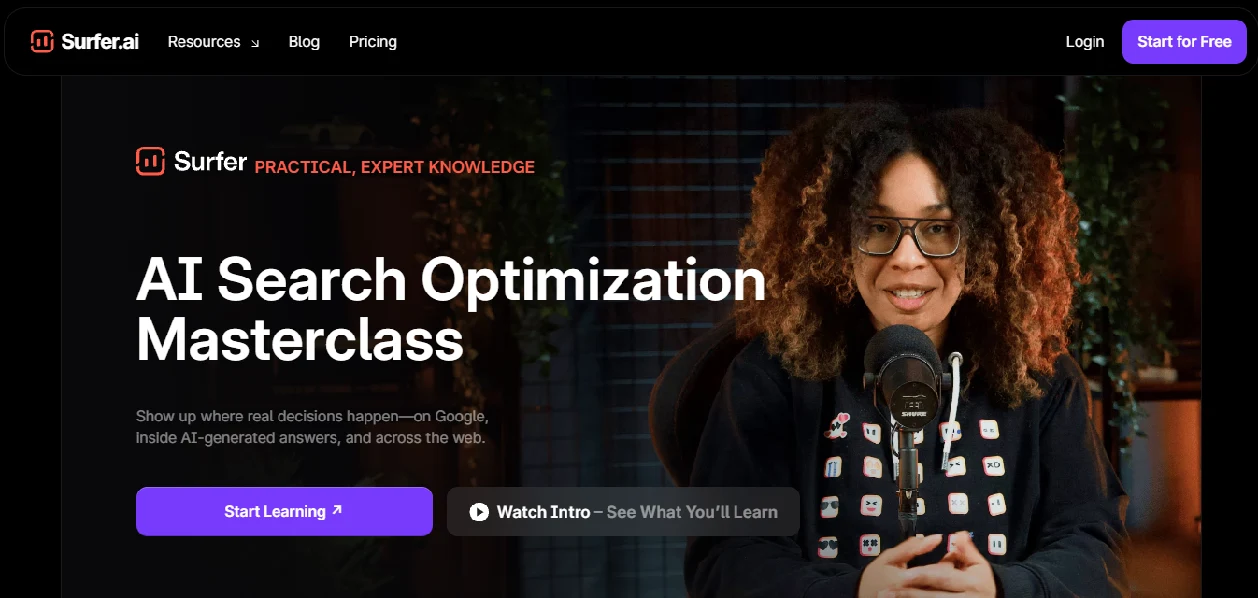
5. Surfer – AI Search Optimization Masterclass
Best free AI SEO course
If you are looking specifically for free AI SEO courses 2026, this is probably the first one I would recommend.
Surfer’s AI Search Optimization Masterclass is free and currently includes 20 lessons across seven modules, approximately two hours of content, six quizzes, downloadable operational templates, real-world examples, and a final exam. Surfer says more than 28,000 people completed the previous course and that it received a 4.7/5 rating.
Looking for more free SEO training? Explore more free SEO courses covering different areas of search, from fundamentals to specialized skills.
More importantly, the curriculum is broader than simple AI-assisted content creation.
It covers:
AI visibility → brand recognition → authority signals → AI-ready content → technical foundations → schema → entities → UGC → topical authority → digital PR → AI visibility measurement → repeatable workflows
Want to start learning AI search without paying for a course? Surfer’s free AI search training is one of the easiest ways to build a practical foundation.
Start Learning FreeThat is a legitimate AI search optimization framework.
Surfer also explicitly covers how user-generated content and community activity can contribute to visibility, which is a useful correction to the common assumption that AI SEO means “optimize my website harder.”
The Reddit conversation I reviewed also contains a direct reference to Surfer’s free AI Search Optimization Masterclass in an SEO-related discussion, reinforcing its visibility among people looking for current AI training.
At a Glance
Last reviewed: October 6, 2026
CoursesMag Expert Score
Score Breakdown
Why this score?
The course covers AI visibility, brand recognition, authority signals, AI-ready content, technical foundations, schema, entities, UGC, topical authority, digital PR, measurement and workflows. It is broad enough for a practical introduction, although not as technically deep as Jellyfish.
Why this score?
Real-world examples, downloadable operational templates, quizzes and repeatable workflows make it more practical than a basic introductory course.
Why this score?
The course is presented by Surfer's own marketing and product team, which provides practical company-side experience but also means the education is vendor-led.
Why this score?
Twenty lessons over roughly two hours make it easy to complete without getting buried in theory.
Why this score?
It is completely free and includes certification, a badge, templates, community access and future updates.
Why this score?
It is useful for building AI-search knowledge, but I would not treat a vendor certificate as equivalent to extensive professional experience or advanced specialist training.
Why this score?
Surfer explicitly says the course receives future updates and that its certification can be renewed because AI search practices evolve.
Pros
- Completely free
- 20 lessons across 7 modules
- Certificate and badge
- Templates and real-world examples
- Strong coverage of authority and digital PR
- Future updates
Cons
- Vendor-led education
- Less technical than Jellyfish
- Not enough for advanced AI-search specialization
- Career value of the certificate itself is limited
Community Score
Ratings from learners — on the source platform and from CoursesMag members.
Learner ratings on the source platform
CoursesMag community rating
The limitation
Surfer is still a software company.
Naturally, some of the course workflow is connected to Surfer’s own product ecosystem. That does not make the course bad, but it is something I keep in mind when evaluating vendor-created education.
My verdict
Highly Recommended
My pick for the best free AI search optimization course for marketers, content teams, and SEOs who want something practical without paying.
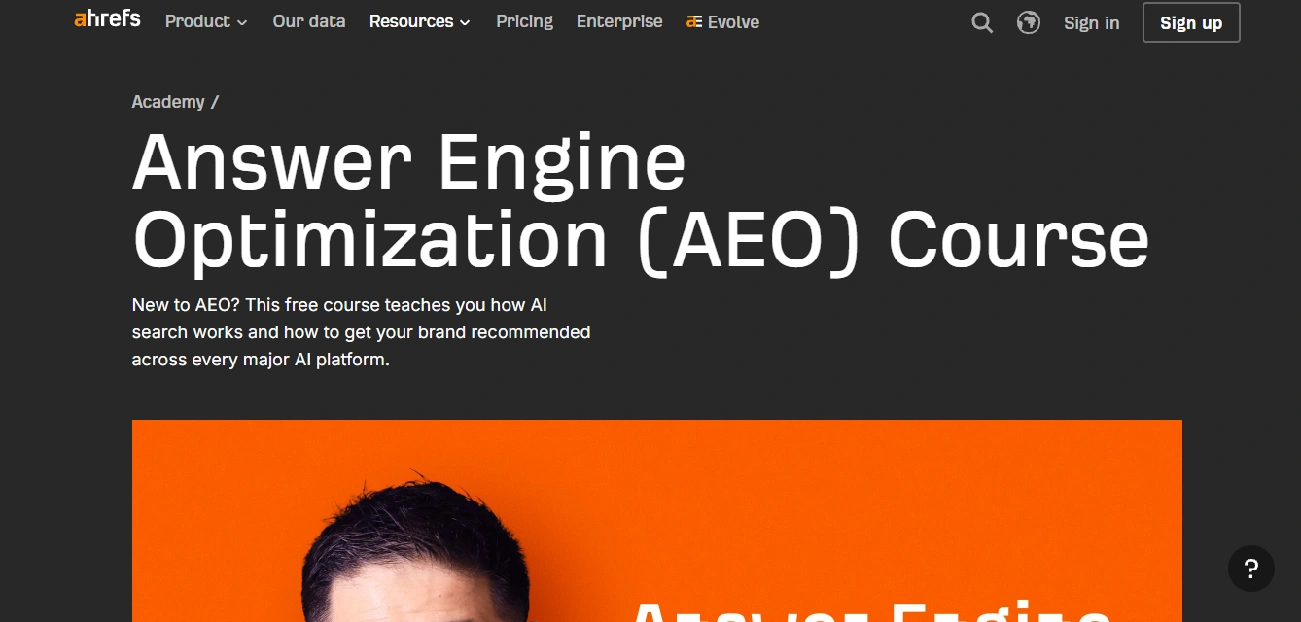
6. Ahrefs Academy – Answer Engine Optimization Course
Best quick AEO foundation
Ahrefs has done something I particularly like here: it kept the course focused.
If you want a broader look at Ahrefs SEO courses, I also reviewed the platform’s main training programs in more detail.
The Answer Engine Optimization Course contains 12 lessons across five modules and takes approximately 1 hour 26 minutes. It is free, requires no sign-up to start, and has a certification exam with 48 questions.
Need a quick introduction to AEO without sitting through a 10-hour program? Ahrefs’ AEO training covers the essential workflow from AI search basics to citations and measurement.
Take the Free CourseDespite its short duration, the curriculum covers the parts that actually matter:
- how AI search works
- how platforms decide what to cite
- prompt research
- keyword research for AEO
- creating citable content
- earning mentions
- YouTube optimization for AI visibility
- technical AEO
- measuring AI traffic
- competitive audits
This is important because it makes the course about more than simply producing AI-friendly copy.
Ahrefs even separates execution and measurement, which is exactly how I think about a serious AEO workflow.
Comparing Ahrefs and Semrush? If you're choosing between the two platforms for SEO training and tools, see how their academies compare in 2026.
At a Glance
Last reviewed: October 6, 2026
CoursesMag Expert Score
Score Breakdown
Why this score?
The course covers the essential AEO workflow: how AI search works, citations, brand gaps, prompt research, citable content, mentions, YouTube, technical AEO and measurement. The limitation is its intentionally short scope.
Why this score?
It contains practical competitive audits, content optimization and measurement guidance, but the 86-minute format naturally limits the depth of implementation.
Why this score?
Sam Oh is an experienced SEO educator and Ahrefs has a strong track record for making complex SEO concepts accessible.
Why this score?
At just 1 hour 26 minutes, this is one of the easiest courses on the list to complete.
Why this score?
The course is completely free, requires no sign-up to start, and includes a 48-question certification exam.
Why this score?
The skills are useful, but the short course should be treated as AEO foundation rather than comprehensive specialist training.
Why this score?
The current material explicitly covers today's AI-search platforms and includes current AEO examples, technical guidance and measurement workflows.
Pros
- Completely free
- Very focused
- No sign-up required
- Covers citations and brand mentions
- Includes technical AEO
- Certification available
Cons
- Too short for advanced training
- Not a full AI SEO curriculum
- Strongly connected to Ahrefs' ecosystem
Community Score
Ratings from learners — on the source platform and from CoursesMag members.
Learner ratings on the source platform
No specific or citable ratings or reviews are available.
CoursesMag community rating
What I like
It is compact and focused.
You can finish it quickly and then start testing the concepts on a real site.
This aligns with an important point raised in the recent Reddit discussions: experienced practitioners repeatedly recommend combining courses with actual websites, testing, Google documentation, and current case studies rather than expecting one course to teach everything.
What I don’t like
It is not a substitute for a full SEO education.
Someone completely new to SEO should not expect a 86-minute AEO course to teach them technical SEO, content SEO, link building, crawling, indexing, and SEO fundamentals from scratch.
My verdict
Highly Recommended
The best choice when you want a free, focused AEO course rather than a large AI SEO training program.
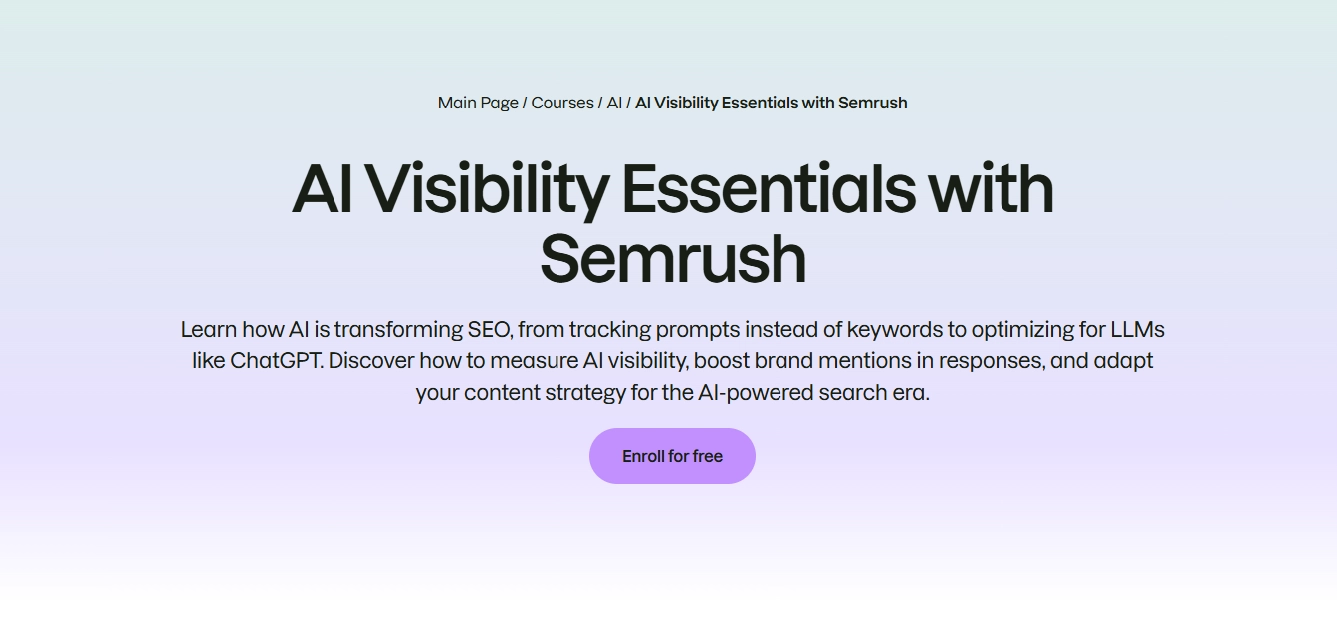
7. AI Visibility Essentials with Semrush
Best AI visibility course for measurement
Semrush’s AI Visibility Essentials takes a slightly different approach from Ahrefs.
Its strongest area is measurement.
The course teaches marketers to think beyond rankings and keywords and instead work with prompts, AI visibility, share of voice, brand perception, third-party mentions, and LLM visibility. It contains 21 lessons and is free, with a certificate available after the final assessment.
If you want to compare this with Semrush’s broader SEO education, see my review of the Semrush SEO courses and training options.
The lesson structure includes practical walkthroughs for:
prompt research → competitor visibility → share of voice → brand perception → third-party brand mentions → AI-friendly content → technical SEO for AI systems → measurement
More interested in measuring AI search performance than learning another set of content tips? Semrush’s AI visibility training puts prompts, mentions, visibility and reporting at the center.
Learn AI Visibility FreeThat makes it particularly relevant for marketers who need to report AI search performance to stakeholders.
I especially like the shift from:
“Where do we rank?”
to:
“How often does our brand appear for the prompts that matter, where does the information come from, and how are competitors being represented?”
That’s a more appropriate measurement question for AI search.
Semrush also includes technical topics such as robots.txt, structured data, website architecture, and crawling.
At a Glance
Last reviewed: October 6, 2026
CoursesMag Expert Score
Score Breakdown
Why this score?
The curriculum focuses on AI visibility, prompt research, brand mentions, clickless search, AI-friendly content, and technical SEO. It is especially strong for understanding the measurement side of AI search.
Why this score?
The course includes practical AI visibility workflows and connects the training directly to Semrush's AI Visibility Toolkit.
Why this score?
The course is built by Semrush educators and subject-matter experts, with a clear workflow-oriented structure.
Why this score?
The full course contains 21 lessons and approximately one hour of material, making it highly accessible.
Why this score?
It is free and includes a certificate.
Why this score?
The measurement skills are useful, but the course is too short to be considered a complete AI SEO specialization.
Why this score?
The current curriculum is explicitly built around prompts, LLM visibility, brand mentions and AI-powered search rather than traditional ranking metrics.
Pros
- Free
- Certificate included
- Excellent focus on measurement
- Covers AI Share of Voice and brand visibility
- Practical Semrush workflows
Cons
- Strongly tied to Semrush
- Short
- Not a deep technical AEO course
- Limited independent learner evidence
Community Score
Ratings from learners — on the source platform and from CoursesMag members.
Learner ratings on the source platform
No specific or citable ratings or reviews are available.
CoursesMag community rating
The limitation
Again, this is a vendor academy.
A meaningful portion of the training involves Semrush’s AI Visibility Toolkit, so I would not treat it as completely tool-agnostic education.
The course is best understood as:
AI visibility fundamentals + Semrush workflow
rather than an exhaustive LLM SEO course 2026.
My verdict
Recommended
The best option on this list for someone whose main goal is AI visibility measurement and reporting.
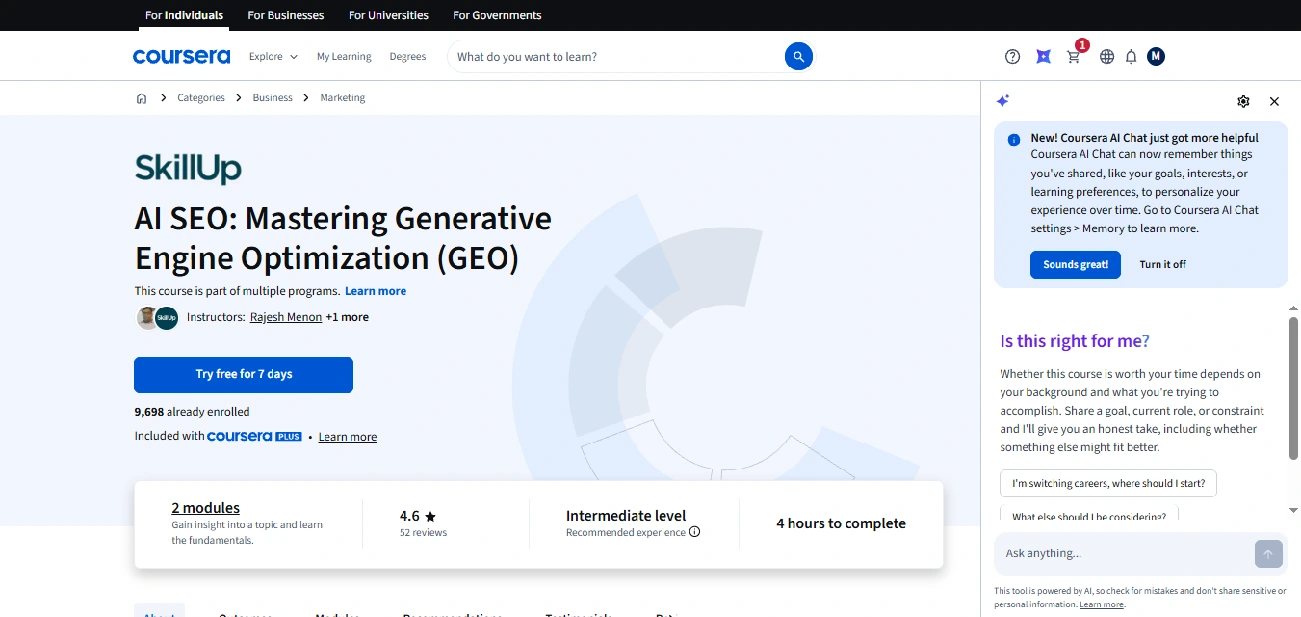
8. Coursera – AI SEO: Mastering Generative Engine Optimization (GEO)
Best structured GEO course
Coursera’s AI SEO: Mastering Generative Engine Optimization (GEO) is a good fit for people who prefer a more traditional online learning structure.
The current course contains two modules, with around three hours of total learning material, graded quizzes, labs, assignments, and a shareable career certificate. Topics include how AI generates answers, entity-based SEO, AI-friendly content formats, GEO metrics, GEO tracking tools, schema and structured data, competitor analysis, and practical content restructuring.
Prefer a more structured learning experience with labs, assessments and a certificate? Coursera’s GEO course gives you a practical introduction to optimizing content for AI-driven search.
Explore the GEO CourseThe learner feedback is also unusually useful because Coursera exposes actual ratings and written reviews. At the time of my review, the course had a 4.6/5 rating from 50 reviews, with 82% five-star reviews. One June 2026 reviewer specifically described it as a structured, step-by-step way to learn AIO and GEO.
That does not make it the deepest course on this list.
Want to explore more SEO training on Coursera? See how other SEO programs on Coursera compare, including courses for beginners and more experienced learners.
But it does make it attractive for someone who wants:
lessons → exercises → quizzes → labs → certificate
rather than purely self-directed learning.
At a Glance
Last reviewed: October 6, 2026
CoursesMag Expert Score
Score Breakdown
Why this score?
The course provides a structured introduction to GEO, covering AI search, entities, context, AI-friendly content formats, schema, GEO metrics and content restructuring. It is more introductory than the specialist courses higher on this list.
Why this score?
The two modules include an AI SEO Content Mapping lab, GEO Metrics Analysis, and a Rewrite for GEO exercise, which gives the course more practical value than a purely theoretical introduction.
Why this score?
Coursera provides a structured learning environment, graded quizzes and practical activities, although the course is relatively short.
Why this score?
The current Coursera page lists approximately 4 hours of learning, at an intermediate level, across two modules.
Why this score?
The course can be enrolled in through Coursera and includes a shareable career certificate. It has more formal learning infrastructure than many free academy courses, although access can depend on the applicable Coursera plan.
Why this score?
The structured certificate and practical exercises provide useful supporting evidence of training, but the course is not deep enough to establish advanced AI SEO expertise by itself.
Why this score?
The current course explicitly covers Google AI Overviews, Perplexity and AI-driven search and includes current GEO practices and metrics.
Pros
- Structured learning environment
- Practical labs and exercises
- GEO-specific curriculum
- Shareable certificate
- Good option for learners who prefer guided education
Cons
- Less technical than Jellyfish
- Less comprehensive than Search Atlas
- GEO-focused rather than full AI SEO
- Intermediate learners may outgrow it quickly
Community Score
Ratings from learners — on the source platform and from CoursesMag members.
Learner ratings on the source platform
CoursesMag community rating
One important limitation
The course is much closer to a GEO introduction than a complete senior-level AI SEO program.
Someone looking for advanced technical concepts around AI crawlers, retrieval systems, query fan-out, or sophisticated AI visibility strategy will probably outgrow it.
My verdict
Recommended
A solid option for learners who want a structured GEO course 2026 with practical exercises and a recognized learning platform.
Coursera or Udemy for SEO? If you're deciding where to learn SEO, compare the two platforms before choosing your next course.
Which AI SEO course is best for you?
The phrase “best AI SEO course” is misleading because the right course depends heavily on your current level and what you are trying to achieve.
Best AI SEO course for beginners
I would start with Surfer or Ahrefs.
Both are free, focused, and short enough that you can actually finish them.
However, I would not make the mistake of treating either one as a replacement for SEO fundamentals.
A beginner still needs to understand crawling, indexing, search intent, keyword research, technical SEO, content quality, internal linking, and authority before trying to become an AI-search specialist.
That is also consistent with the recent Reddit discussions: some practitioners argue that the fundamentals remain largely intact, while others emphasize that AI has introduced genuinely new search behavior and workflows. The practical answer is to learn both rather than choose one.
Best AI SEO course for experienced SEOs
CXL is my first choice.
You already know SEO. What you need is not another beginner explanation of title tags.
You need to understand what happens when search becomes an AI-mediated research process.
Best advanced AI SEO course
I’d choose Jellyfish for technical depth and SEOSLY for breadth.
Jellyfish goes deeper into the mechanics of generative retrieval and technical considerations. SEOSLY provides a much broader framework covering data, implementation, strategy, tools, audits, and a capstone project.
Best AI SEO course for marketers
Surfer is the easiest free starting point.
Semrush is especially useful when measurement and reporting are major parts of your role.
Best AI SEO course for agencies
I would lean toward SEOSLY or Jellyfish.
Agencies need more than content prompts. They need audit processes, implementation frameworks, reporting, technical considerations, and ways to communicate AI search work to clients.
What should an AI SEO course actually teach?
This is the checklist I would use before paying for any AI SEO certification course or advanced training program.
1. AI search mechanics
A serious course should explain how AI systems retrieve, combine, and synthesize information.
Ideally, this includes concepts such as:
RAG, query fan-out, entities, retrieval, context, chunking, and source selection.
Jellyfish is especially strong in this area.
2. AI search visibility
A good program should teach you how to determine whether your brand is actually appearing in AI-generated answers.
Look for:
prompt research, visibility tracking, share of voice, brand perception, citation frequency, and competitor comparison.
This is where Semrush and SEOSLY stand out.
3. LLM citations and AI citations
A modern course should answer a much more useful question than “How do I write content for AI?”
It should teach:
Why would an AI system cite this page instead of another one?
That requires understanding source authority, content structure, entities, external mentions, and information that is actually useful to retrieve.
Ahrefs explicitly covers how AI platforms decide what to cite, how to create citable content, and how to earn mentions.
4. Entity SEO and structured data
I am skeptical of any AI SEO course that treats schema as a magic GEO button.
Structured data can help machines interpret content and entities, but it is only one part of a much larger system.
The strongest programs place structured data, entity SEO, content structure, authority, and external validation together rather than pretending one technical tweak will make a brand appear in ChatGPT.
Surfer, Jellyfish, and SEOSLY all include versions of these topics in their curricula.
5. External validation and brand mentions
This is one of the biggest differences between traditional on-page SEO thinking and AI search optimization.
You cannot assume that your website is the only source an LLM uses to understand your brand.
A strong AI SEO training program should therefore address:
brand mentions → citations → third-party sources → communities → digital PR → trusted references
Jellyfish, Ahrefs, Semrush, Maven, and Surfer all incorporate this external dimension to varying degrees.
6. Technical AI SEO
Technical SEO still matters.
But in an AI-search environment, I want a course to go beyond generic technical checklists.
Look for discussion of:
AI crawlers, accessibility, JavaScript, structured data, machine-readable formats, site architecture, crawling, retrieval and content processing.
This is another reason Jellyfish stands out.
If you want to strengthen that foundation, these technical SEO courses options cover the technical side of search in more depth.
7. Practical work
I would choose a hands-on AI SEO course over a much longer course that contains nothing but lectures.
The strongest signals are:
real projects, labs, audits, templates, assignments, case studies, dashboards, and capstone work.
This is one of the strongest advantages of SEOSLY and Coursera, while Surfer adds quizzes, templates, and practical examples.
Do you need an AI SEO certification in 2026?
Not necessarily.
I would not choose an AI SEO certification 2026 program simply because it gives you a certificate.
A certificate can demonstrate that you completed training. It does not prove that you can get a brand cited in ChatGPT, improve AI search visibility, solve a technical SEO problem, or grow organic traffic.
For a professional SEO, I would generally rank these signals above the certificate itself:
real projects → measurable results → case studies → technical competence → ability to explain your methodology → certificate
The certificate becomes a useful supporting signal, not the main reason to buy the course.
The difference is obvious when comparing the programs here.
Ahrefs offers a certification exam; Surfer has a final exam and certificate; Semrush offers certification; Coursera provides a shareable career certificate.
But those credentials are only useful when backed by actual SEO ability.
AI-assisted SEO vs AI search optimization
This distinction deserves its own section because I think many buyers are still getting misled by it.
An AI-assisted SEO course might teach you how to use ChatGPT to:
- generate content briefs
- cluster keywords
- summarize competitor pages
- analyze datasets
- draft schema
- automate repetitive SEO tasks
- create reports
That’s useful.
I use AI tools for these types of workflows myself.
But that doesn’t automatically teach you how to get a brand cited in an AI-generated answer.
That’s a different problem.
A true AI search optimization course should teach you to think about:
- What information does the model need?
- Which sources does it trust?
- How is the information retrieved?
- How clearly are entities and relationships expressed?
- What third-party sources validate the brand?
- What prompts actually matter to the business?
- How will we measure whether visibility changed?
That’s the layer I would prioritize in 2026.
Are GEO and AEO really different from SEO?
Yes and no.
This is one area where the SEO community disagrees.
Some practitioners argue that most of modern GEO and AEO is simply traditional SEO fundamentals applied to a different retrieval environment. Others argue that generative search introduces fundamentally different optimization problems.
The Reddit discussions I reviewed show both views. Some experienced practitioners describe the new terminology as largely repackaged SEO fundamentals, while others argue that AI search behavior is changing quickly enough that SEOs need new methods and experimentation.
My view is somewhere in the middle.
The foundation is still SEO.
But the optimization target has expanded.
You are no longer optimizing solely for:
rankings → clicks → website visits
You may also be optimizing for:
retrieval → inclusion → citation → recommendation → brand visibility → conversion
That does not make traditional SEO irrelevant.
It makes the job bigger.
Final verdict: which AI SEO course should you take?
There is no single best AI SEO course in 2026 for everyone.
For someone already working professionally in SEO, I would not spend money on a course simply because it contains the words AI, GEO, or AEO in the title.
I would start with the problem you need to solve.
Need a focused understanding of AI-powered comparisons and citable content? Take CXL.
Need deeper technical understanding of AEO, GEO, retrieval, query fan-out, and AI accessibility? Take Jellyfish.
Need the broadest self-paced program with audits, dashboards, practical work, and a capstone? Take SEOSLY.
Need a short live AEO program with discussion and interaction? Look at Maven.
Need a strong free starting point? Start with Surfer or Ahrefs.
Need to understand measurement and AI share of voice? Take Semrush.
Want a more structured GEO learning experience with labs and assessments? Coursera is a good fit.
But there is one thing I would tell every SEO before buying any AI SEO training:
Don’t stop learning when the course ends.
AI search is moving too quickly for a static curriculum to remain sufficient for long. The most useful skills will come from combining formal training with real websites, prompt testing, competitor analysis, Google documentation, current case studies, and your own experiments. That is also one of the clearest themes emerging from the current SEO community: learn the framework, then test it against reality.
In other words, the goal is not to become someone who has completed an AI SEO certification course.
The goal is to become the SEO who can look at a real business, understand how it is represented across Google AI Overviews, Google AI Mode, ChatGPT, Perplexity, Gemini, and other AI search systems, diagnose why it is or is not being surfaced, and build a strategy that improves its visibility.
That is what makes AI SEO worth learning in 2026.